


 Across industries, the economics of compute have changed fundamentally. Standard commercial hardware – servers, memory, storage and general compute infrastructure – has become more expensive, harder to source and significantly slower to procure. Delivery times of six to twelve months, once unthinkable, are now common.
A global shift in hardware economics
This is not a telecom specific issue. It is the result of global demand for compute capacity, driven by AI hyperscalers, combined with supply chain fragmentation, export controls and limited semiconductor investment in mature process nodes. Yet the impact on telecom operators is particularly visible, because networks depend on predictable access to compute resources for both legacy and next generation services.
Why hardware is becoming harder to obtain
AI infrastructure consumes enormous quantities of the same hardware that telecom workloads rely on. Hyperscalers are willing to pay a premium to secure supply, which pushes other industries – including telecom – further back in the queue. At the same time, geopolitical developments and currency volatility add uncertainty to procurement cycles, especially for operators budgeting in local currencies while purchasing equipment priced in US dollars.
The semiconductor industry adds another structural constraint. Mature process nodes (28–90 nm), heavily used in networking and signaling hardware, have seen limited new investment compared to cutting edge nodes used for AI chips. This means that the hardware most relevant to telecom operators is precisely where supply is tightest.
The result is a long term shift: hardware is more expensive, less predictable and harder to source than at any point in the past decade.
Impact across the entire network – not just legacy
Although ageing STPs, DRAs and HLRs are clear examples of hardware dependent platforms, the challenge extends far beyond legacy systems. Modern 5G core deployments, private cloud environments and virtualized network functions all rely on compute capacity that is subject to the same market pressures.
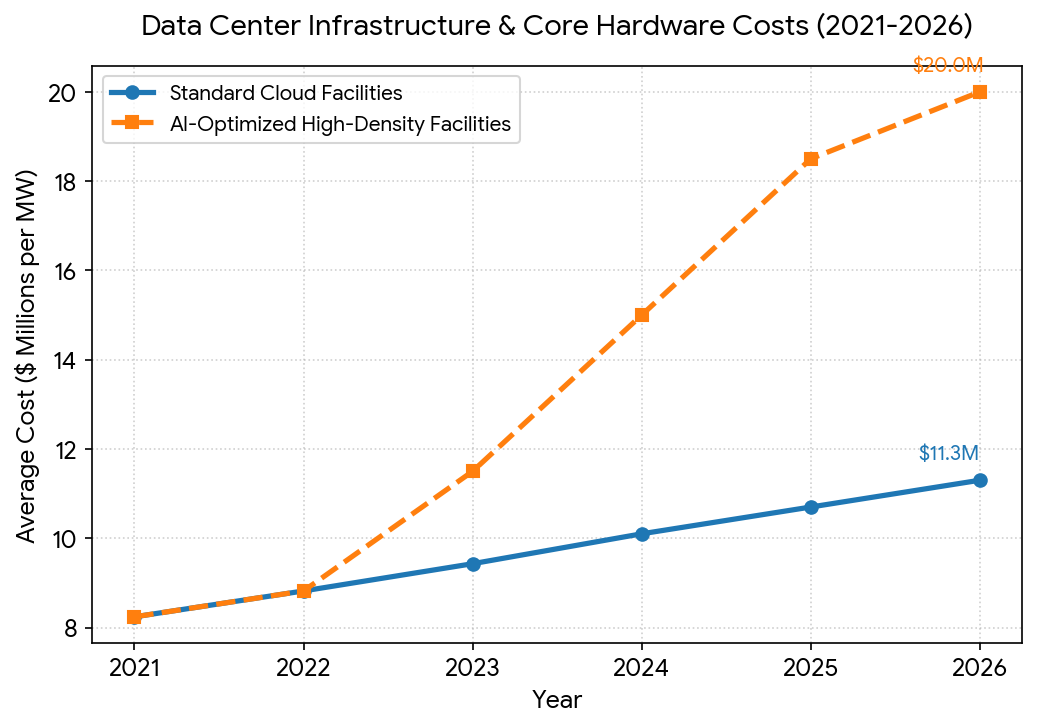
Operators deploying new 5G services often need to expand their on premise hardware footprint or secure additional cloud compute resources. Both options have become more costly and less predictable. Even cloud environments are not immune: hyperscalers face the same hardware constraints, and rising demand for AI workloads influences cloud pricing and availability.
In short, whether an operator is maintaining legacy networks or rolling out new 5G capabilities, the underlying requirement is the same: compute must be available, affordable and reliable. Today, that assumption can no longer be taken for granted.
The strategic need to reduce hardware dependency
In this environment, reducing dependency on dedicated hardware becomes a strategic priority. Operators increasingly look for ways to maintain full network capability without tying critical functions to specific appliances, proprietary hardware cycles or unpredictable supply chains.
This is where software defined signaling architecture becomes essential. By decoupling signaling functions from hardware, operators gain flexibility at a moment when flexibility is becoming a necessity rather than a luxury.
A unified software approach to signaling
BroadForward’s GSMA award winning BFX Unified Signaling Core (USC) is designed to address exactly this challenge. Instead of relying on dedicated hardware platforms, BFX provides a vendor agnostic, software based signaling solution that can run on standard COTS servers, virtual machines, containers or cloud infrastructure.
BFX supports SS7, Diameter, HTTP/2 and 5G SBA interfaces within a single architecture. This allows operators to consolidate multiple signaling functions – including STP, DRA, SEPP, SCP and interconnect security – into one unified platform. The result is a modern signaling environment that preserves full multi generation capability while dramatically reducing hardware exposure.
How software limits the impact of rising hardware costs
By moving signaling functions to a unified software platform, operators can scale capacity using whichever compute resources are available, whether on premises or in the cloud. They avoid the cost and uncertainty of proprietary hardware refresh cycles and gain the freedom to source standard hardware from multiple suppliers.
This approach also supports long term sustainability. Operators can maintain 2G, 3G, 4G and 5G signaling on modern infrastructure without investing in hardware that vendors are phasing out. At the same time, they benefit from improved security, easier lifecycle management and a significantly smaller hardware footprint.
Conclusion: resilience through software
There is a global shift in compute economics that affects every operator. Hardware scarcity and rising costs are structural realities that will continue to shape procurement strategies for years to come.
Operators who reduce their exposure to hardware constraints – and who adopt software defined architectures that can run anywhere – will be better positioned to control cost, manage risk and maintain service continuity.
BroadForward’s Unified Signaling Core is engineered for exactly this purpose: enabling operators to sustain multi generation network obligations efficiently, cost effectively and on infrastructure that can evolve with the demands of the next decade.
*Source: Data used to create the graph is compiled from leading global real estate, data center construction, and commercial infrastructure indices, including JLL 2026 Global Data Center Outlook, Archdesk 2026 AI Data Center Construction Analysis, Turner & Townsend Data Centre Cost Index and Encor Advisors Data Center Cost Guide