


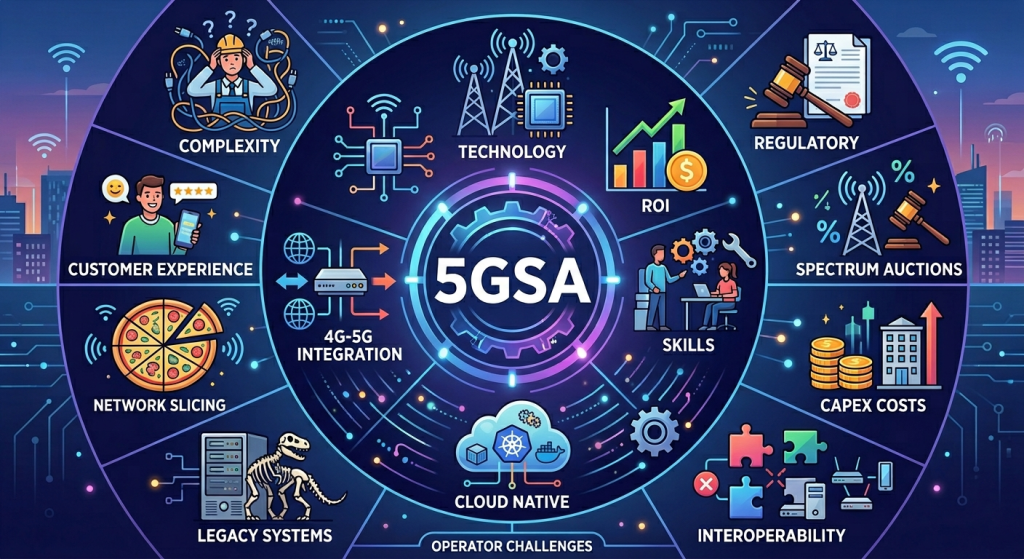
Ever since the very first deployment in Korea in April 2019, 5G Standalone (5GSA) has been hailed as the fastest-growing mobile technology in history. Yet global adoption remains far behind expectations. As of March 2026, of a total of approximately 1,400 operators, 95 operators have launched 5GSA.
Operators face a complex transition. They’re shifting from legacy architectures to service‑based 5G Cores, adopting new signaling protocols, and embracing cloud‑native operations. All of this is happening while the business case for 5G monetization remains uncertain.
One of the many challenges, however, has quietly become one of the big blockers to global 5GSA readiness: the practical deployment requirements of key 5G Core functions.
5G Core readiness: the hidden barrier to 5GSA progress
5GSA only delivers its full value when operators can deploy and integrate the essential 5G Core functions that enable new services, automation, and interconnectivity.
Yet despite their importance, many 5G Core functions are designed exclusively for cloud‑native environments. In theory, this aligns with the long‑term vision for 5G. In practice, it creates a structural mismatch: the majority of operators are not cloud‑ready.
Industry surveys show that nearly 70% of operators still operate primarily on physical or virtualized infrastructure (Heavy Reading / Omdia 5G Core Operator Survey 2025). Juniper Research similarly notes that fewer than half of operators will deliver cellular services using cloud infrastructure by 2028. The result is a global deadlock: operators cannot activate 5GSA services without key 5G Core functions – but many cannot deploy those functions because they are cloud‑native only.
A more realistic path: 5GSA within the operator’s current environment
The industry often frames cloud‑native as a destination – but overlooks the journey. Operators vary widely in infrastructure maturity, operational models, and investment cycles. For many, cloud adoption is a multi‑year process, not an immediate step. A sustainable 5G strategy must therefore support:
- Hybrid deployment models
- Incremental modernization
- Reuse of existing infrastructure and skills
- Avoidance of temporary or duplicate environments
When 5G Core functions require cloud readiness from day one, they introduce unnecessary cost, risk, and delay. Operators face repeated integration cycles, duplicate licensing, and rework when eventually migrating to cloud. These inefficiencies weaken the 5G business case at a time when ROI is already under pressure.
Breaking the bottleneck: 5G Core functions without cloud dependency
A more pragmatic approach is emerging. It enables key 5G Core functions like SEPP and SCP to run consistently across bare metal, virtual machines, and containers. These functions can even migrate between environments without reconfiguration or downtime. This flexibility fundamentally changes the economics and feasibility of 5GSA rollout:
- Operators can activate 5GSA services immediately, using the infrastructure they already have.
- Cloud adoption becomes optional, not mandatory, and can follow the operator’s own timeline.
- Costs drop significantly, as temporary cloud environments, duplicate engineering work, and parallel licensing are no longer required.
- Risk is reduced, because operational teams can work within familiar environments.
- Global readiness improves, especially in regions where cloud maturity lags.
This model levels the playing field. It enables both advanced and emerging markets to participate in 5GSA sooner, strengthening the global ecosystem and accelerating service innovation. This is why we see early indicators in the market: leading operators, IPX providers, and IoT platforms are prioritizing 5G Core solutions that support hybrid deployment models. They recognize that flexibility – not cloud purism – is what will unlock the next phase of 5G growth.
Toward a more sustainable 5G future
The industry’s long‑term vision for cloud‑native networks remains valid. But insisting on cloud‑native readiness as a prerequisite for 5GSA deployment has slowed progress more than it has accelerated it. A sustainable strategy acknowledges that modernization is a journey, and that operators need solutions designed for every step, not just the end state. By removing cloud dependency from 5G Core deployment, the industry can:
- Accelerate global 5GSA rollout
- Reduce deployment costs
- Improve ROI
- Expand inclusion across markets
- And ultimately strengthen the business case for 5G
5G Core functions should be enablers, not barriers.
Learn more about BroadForward’s approach to flexible, future‑proof 5G Core deployment
For service providers looking to activate 5GSA services without cloud‑related delays or costs, BroadForward offers SEPP and SCP solutions designed to be deployed and operate at every stage of the modernization journey.
Also see:
Industry Perspectives: The 5G Service Communication Proxy (SCP) as a core intelligence layer
Read: 5G SCP: Evolving as a core intelligence layer
Industry perspectives: Adoption of SEPP for 5G roaming
Read: The adoption of SEPP for 5G roaming – why It matters and what’s next