BroadForward SEPP powers the world’s first live 5G standalone roaming connection
Achieving the highest GSMA recognition as the leading signaling experts
World-class signaling products: when progress matters to you
Providing network functions to the world’s leading MNOs, MVNOs, IoT, MNP and IPX providers

SCP

Industry perspectives: Why 5G Standalone Still Isn’t Universal

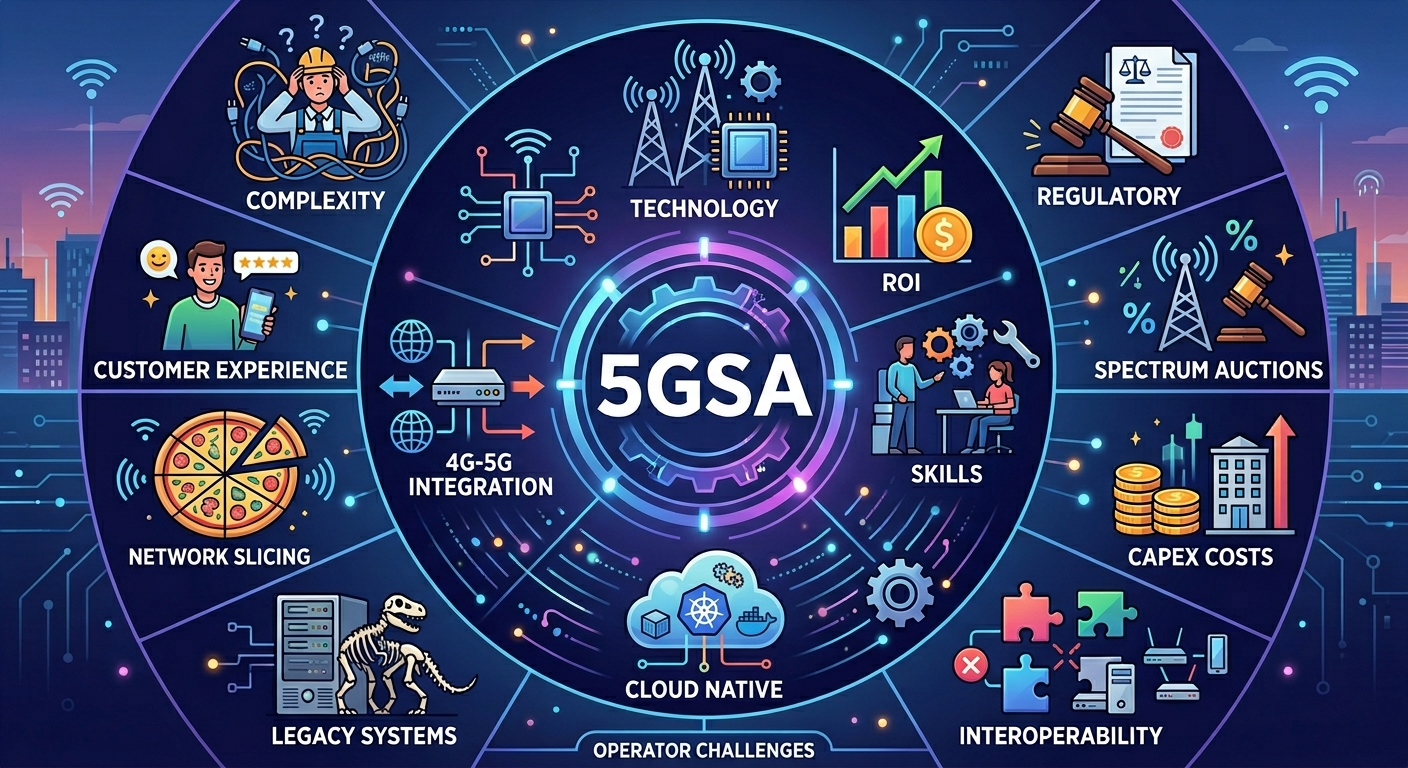
Ever since the very first deployment in Korea in April 2019, 5G Standalone (5GSA) has been hailed as the fastest-growing mobile technology in history. Yet global adoption remains far behind expectations. As of March 2026, of a total of approximately 1,400 operators, 95 operators have launched 5GSA. Operators face a complex transition. They’re shifting from legacy architectures to service‑based 5G Cores, adopting new signaling protocols, and embracing cloud‑native operations. All of this is happening while the business case for 5G monetization remains uncertain. One of the many challenges, however, has quietly become one of the big blockers to global 5GSA readiness: the practical deployment requirements of key 5G Core functions. 5G Core readiness: the hidden barrier to 5GSA progress 5GSA only delivers its full value when operators can deploy and integrate the essential 5G Core functions that enable new services, automation, and interconnectivity. Yet despite their importance, many 5G Core functions are designed exclusively for cloud‑native environments. In theory, this aligns with the long‑term vision for 5G. In practice, it creates a structural mismatch: the majority of operators are not cloud‑ready. Industry surveys show that nearly 70% of operators still operate primarily on physical or virtualized infrastructure (Heavy Reading / Omdia 5G Core Operator Survey 2025). Juniper Research similarly notes that fewer than half of operators will deliver cellular services using cloud infrastructure by 2028. The result is a global deadlock: operators cannot activate 5GSA services without key 5G Core functions - but many cannot deploy those functions because they are cloud‑native only. A more realistic path: 5GSA within the operator’s current environment The industry often frames cloud‑native as a destination - but overlooks the journey. Operators vary widely in infrastructure maturity, operational models, and investment cycles. For many, cloud adoption is a multi‑year process, not an immediate step. A sustainable 5G strategy must therefore support:
  • Hybrid deployment models
  • Incremental modernization
  • Reuse of existing infrastructure and skills
  • Avoidance of temporary or duplicate environments
When 5G Core functions require cloud readiness from day one, they introduce unnecessary cost, risk, and delay. Operators face repeated integration cycles, duplicate licensing, and rework when eventually migrating to cloud. These inefficiencies weaken the 5G business case at a time when ROI is already under pressure. Breaking the bottleneck: 5G Core functions without cloud dependency A more pragmatic approach is emerging. It enables key 5G Core functions like SEPP and SCP to run consistently across bare metal, virtual machines, and containers. These functions can even migrate between environments without reconfiguration or downtime. This flexibility fundamentally changes the economics and feasibility of 5GSA rollout:
  • Operators can activate 5GSA services immediately, using the infrastructure they already have.
  • Cloud adoption becomes optional, not mandatory, and can follow the operator’s own timeline.
  • Costs drop significantly, as temporary cloud environments, duplicate engineering work, and parallel licensing are no longer required.
  • Risk is reduced, because operational teams can work within familiar environments.
  • Global readiness improves, especially in regions where cloud maturity lags.
This model levels the playing field. It enables both advanced and emerging markets to participate in 5GSA sooner, strengthening the global ecosystem and accelerating service innovation. This is why we see early indicators in the market: leading operators, IPX providers, and IoT platforms are prioritizing 5G Core solutions that support hybrid deployment models. They recognize that flexibility - not cloud purism - is what will unlock the next phase of 5G growth. Toward a more sustainable 5G future The industry’s long‑term vision for cloud‑native networks remains valid. But insisting on cloud‑native readiness as a prerequisite for 5GSA deployment has slowed progress more than it has accelerated it. A sustainable strategy acknowledges that modernization is a journey, and that operators need solutions designed for every step, not just the end state. By removing cloud dependency from 5G Core deployment, the industry can:
  • Accelerate global 5GSA rollout
  • Reduce deployment costs
  • Improve ROI
  • Expand inclusion across markets
  • And ultimately strengthen the business case for 5G
5G Core functions should be enablers, not barriers. Learn more about BroadForward’s approach to flexible, future‑proof 5G Core deployment For service providers looking to activate 5GSA services without cloud‑related delays or costs, BroadForward offers SEPP and SCP solutions designed to be deployed and operate at every stage of the modernization journey.   Also see: Industry Perspectives: The 5G Service Communication Proxy (SCP) as a core intelligence layer Read: 5G SCP: Evolving as a core intelligence layer Industry perspectives: Adoption of SEPP for 5G roaming Read: The adoption of SEPP for 5G roaming – why It matters and what’s next Read more

BroadForward signaling security portfolio awarded champion status in Kaleido’s Roaming Vendor Hub report

Strengthened scoring criteria and expanded benchmarking underscore BroadForward’s leadership in global roaming signaling security and Firewall solutions Amersfoort, 19 November 2025, Kaleido today announced that the BroadForward signaling security portfolio has been awarded Champion status in the latest Kaleido Roaming Vendor Hub Report, reaffirming the company’s position at the forefront of innovation and excellence in global roaming and interconnect security. This recognizes BroadForward as one of the top-performing vendors in the signaling security category. Kaleido Intelligence’s Roaming Vendor Hub Report is widely regarded as the roaming industry’s most comprehensive and credible competitive intelligence study. The 2025 edition encompasses five months of rigorous research, evaluating 79 vendors and 185 roaming product offerings across 10 service areas. Its findings play a key role in guiding operators as they evaluate partners across an increasingly complex roaming landscape. Within the signaling security category, where 21 providers were assessed in depth, BroadForward’s outstanding performance secured its Champion status despite the heightened difficulty of this year’s scoring framework. Nitin Bas, Chief of Strategy & Insights at Kaleido Intelligence commented; “BroadForward’s ranking stands out as one of the strongest four among the 21 signaling security providers evaluated this year. Achieving Champion status was more difficult than ever due to raised scoring thresholds raised. Yet BroadForward exceeded the new benchmark with a performance that clearly reflects its technical leadership, innovation velocity, and consistent delivery to operators. Their results place them firmly among the most influential players shaping the future of roaming security.” BroadForward’s leadership in signaling security and interconnectivity has been built over years of delivering advanced, software-defined solutions such as DRA, STP, SEPP and multi-protocol signaling firewalls. Its technology is relied upon by many of the world’s most prominent IPX and IoT providers. Also see: Comfone Launches 5G SA Roaming with BroadForward SEPP Wireless Logic deploys BroadForward’s Unified Signaling Core Türk Telekom International chooses BroadForward STP, DRA and Firewalls Arelion Launches Global 5G Roaming Solution with BroadForward Industry perspectives: The Ghost in the machine: Why Telecoms can no longer trust the past BroadForward’s innovation track record also includes nine GSMA nominations for Best Mobile Technology and the highest GSMA recognition for Best Mobile & Network Software Breakthrough and Best Digital Tech Breakthrough. For full details, the Kaleido Roaming Vendor Hub Report is available here About Kaleido Kaleido Intelligence is a specialist research firm focused on mobile roaming, connectivity, and emerging telecom technologies. Recognized for its rigorous methodology and deep market insight, Kaleido provides the industry’s most comprehensive competitive intelligence across roaming, signaling security, IoT connectivity, private networks, and mobile data. Its annual Roaming Vendor Hub Report is widely regarded as the definitive benchmark for evaluating vendor performance, offering unparalleled transparency, detailed product analysis, and independent scoring built on extensive primary research. Kaleido’s insights guide operators, vendors, and ecosystem partners worldwide as they navigate the evolving landscape of global connectivity. Read more

Wireless Logic reduces complexity across global networks with BroadForward’s single signaling platform

Award-winning signaling software from BroadForward cuts complexity, streamlines operations and future proofs Wireless Logic’s multi-network infrastructure Amersfoort – September 2, 2025 – BroadForward has extended its strategic partnership with Wireless Logic, a leading global Internet of Things (IoT) solutions provider. BroadForward provides intelligent signaling software that helps Wireless Logic unify and simplify signaling operations across its 2G, 3G, 4G and 5G networks, improving efficiency and strengthening core infrastructure. BroadForward’s Unified Signaling Core (BFX) is already deployed across several Wireless Logic Group companies, including Wireless Logic UK, Webbing and COM4, supporting key functions such as STP, DRA, DEA, SCP and SEPP and signaling firewalls. The platform enables seamless communication across technologies and vendors, allowing Wireless Logic to manage complex deployments with greater consistency and control. Also see: Transforma Insights study identifies market leaders and key trends in IoT connectivity As IoT networks continue to evolve, many operators face mounting infrastructure complexity, with different generations of mobile technology layered across diverse systems and vendors. This increases operational overheads, hinders efficient service delivery and complicates the transition to newer technologies. BroadForward addresses these challenges with its award-winning BFX platform – a flexible software architecture that powers its signaling products. Recognized with a GSMA Award for Best Mobile & Network Software Breakthrough, BFX provides a unified framework that ensures consistent management and operational agility across all network functions and technologies. It also supports deployment on virtual machines, containers or bare metal – adapting easily to different environments. “BroadForward's solutions have already strengthened our signaling capabilities, driving greater operational efficiency,” said James Dennis, Group CTO Mobile Core & Global Network at Wireless Logic. “This extended partnership helps us to future-proof our infrastructure and maintain a clear strategic focus on delivering seamless connectivity to our customers worldwide.” “We’re proud to expand our partnership with the Wireless Logic Group,” said Taco Schoute, CEO of BroadForward. “This partnership highlights the flexibility and depth of the BFX Unified Signaling Core in powering multi-generation networks.” The extended collaboration positions Wireless Logic to continue leading the global IoT space with resilient, secure and scalable connectivity solutions. Also see: Cloud IoT connectivity solution for Roaming, Routing, Security and Interworking   About Wireless Logic Wireless Logic is a global leader in Internet-of-Things (IoT) connectivity, dedicated to bridging the physical and digital worlds with seamless, secure, and scalable solutions. With more than 18 million devices connected across 165 countries and direct partnerships with 50+ mobile and satellite operators, they offer global coverage and end-to-end IoT services which accelerate the success of IoT projects.  Conexa, a purpose-built platform and dedicated IoT network, enables customers to securely connect and manage assets across any network and any number of deployments. This simplifies operations, accelerates time to market, lowers the total cost of ownership, and ensures ultra-reliable connectivity.  Their IoT services are meticulously designed, tested, deployed, and managed to meet the specific needs of each customer device fleet. They strive to deliver the most reliable, flexible, and secure connectivity services in the market.  Wireless Logic's customers range from global enterprises and governments to startups and SMEs, and they operate across a wide range of market sectors, including agriculture, healthcare, manufacturing, security, transport, energy, utilities, and smart cities. Backed by Montagu, a leading mid-market private equity firm, and General Atlantic, a leading global investor, Wireless Logic benefits from unrivalled financial strength and continued investment in growth and innovation.  https://wirelesslogic.com Read more

Industry Perspectives: The 5G Service Communication Proxy (SCP) as a core intelligence layer

Enabling smart, secure signaling in the 5G Core

With nearly 100 standalone 5G Core deployments worldwide, one reality is becoming clear: without intelligent signaling control, scaling 5G will cost operators more than just bandwidth, it could cost them agility. Central to this is the Service Communication Proxy (SCP), a key innovation that takes signaling well beyond the roles played by legacy routing nodes like the STP (SS7) and DRA (Diameter). What is the SCP and why is it important? The SCP is a central intermediary acting as a smart signaling proxy for all service-to-service communication in the 5G Core. Instead of routing messages based on static tables, it dynamically discovers services through the Network Repository Function (NRF) and optimizes communication across distributed Network Functions (NFs) using HTTP/2. Leveraging concepts from cloud-native and IT environments, the SCP provides operators with:
  • Dynamic service discovery and smart routing
  • Built-in load balancing and traffic prioritization
  • Security through mTLS and token-based access
  • Observability with native logging, tracing
  • Network resilience
These capabilities reduce operational overhead, improve robustness, and simplify NF onboarding, which is critical in fast-evolving, multi-vendor 5G environments. How the SCP is evolving like STP and DRA did Just as the STP and DRA emerged to manage increasingly complex signaling in 2G/3G and 4G mobile networks, the SCP is evolving to meet the demands of service-based 5G networks. But it will be relevant in many more ways than its predecessors, as it is a policy-aware, service-oriented controller with advanced roles in:
  • Service authentication and authorization
  • Overload protection and policy enforcement
  • Parameter harmonization across vendors and interfaces where feasible
  • Interworking between legacy (4G) and new (5G) functions
  • Protocol translation, supporting HTTP/2, Diameter, and even SS7
Without the SCP, operators risk a growing complexity and higher signaling costs, as they scale 5G and bridge it with legacy systems. Furthermore, the SCP will likely remain a key signaling hub for 6G as well, as the NGMN announced 6G should be viewed as a seamless evolution – fully compatible with 5G and propelled by continuous software innovation. Understanding SCP Deployment Models For the communication between Network Functions (NF), 3GPP has defined four models (A, B, C and D) encompassing direct and indirect scenarios between a Consumer NF and a Producer NF. In Release 15, 3GPP introduced a direct communication mode between Consumers and Producers NFs. This model of communication does not necessitate any proxy between NFs (no SCP is used). Within this direct mode of communication, there are two distinct options. Model A operates without involving the NRF (Network Repository Function), while Model B utilizes the NRF to handle service discovery and registration processes, maintaining updated records of NF status and their profiles. Indirect communication between NFs was introduced in 3GPP Release 16 to shift discovery and selection responsibilities away from NFs. Here the SCP comes into play, as an intermediary to proxy and mediate signaling between service consumers and producers. The role of the SCP in this architecture is conceptually similar to that of the STP and DRA in 2G/3G and 4G mobile core networks. In Model C, NFs need to communicate with the NRF for service discovery and producer instance or set selection. For the latter, the SCP performs the producer instance selection and load balancing based on the optional NF set discovery parameter included in the HTTP/2 request message from the NFs. Within Model D, the SCP acts as a full-service broker, where all discovery tasks are delegated to the SCP; it communicates with the NRF, applies NF instance selection and load balancing based on real time NRF response data. Put simply, Model C relies on the NF to discover its target via the NRF and uses the SCP solely for routing, whereas in Model D, the SCP manages both discovery and routing on the NF’s behalf. Real-world deployment lessons BroadForward’s initial SCP deployments across various Tier-1 and Tier-2 operators show several recurring realities:
  • Our SCP deployments rarely follow “Model D only” deployment – and our SCP has been deployed to support both Model C and D.
  • Some 5G Core Network Equipment Providers (NEPs) mandate Model D deployment, limiting SCP vendor options as not all support Model D yet.
  • Approximately half of our SCP deployments are initially deployed on Virtual Machines. Many deployments typically start with either VMs or bare metal, offering the option to scale up or transition to the cloud (in containers) later, as and when desired.
  • Not all Network Equipment Providers (NEPs) permit the deployment of third-party network elements within the 5G private clouds they offer with their 5G Cores. Operators should assess if such limitation aligns with their multi-vendor strategy and migration and expansion plans.
  • Integration across technologies is a major aspect of SCP deployments, as coexisting 4G-5G network environments are the norm for the foreseeable future, rather than an exception.
  • Almost all operators require our SCP to perform message manipulation and multi-protocol interworking. A notable recent case involved a national operator using the SCP to extend 4G OCS and PCRF systems into the 5G Core, preserving existing investments while enabling 5G features.
  • In multiple cases operators use our SCP to apply intelligent business logic, for instance to perform external database lookups.
Conclusion: SCP as a core intelligence layer The SCP is not just another signaling router; it’s the evolving intelligence layer of the 5G Core. It enables smart routing, NF discovery, load management, security, and legacy interworking functions that are crucial for vendor interoperability and cost-efficient scaling. BroadForward’s experience shows that the first real-world SCP deployments are far more diverse than the standardization guidelines suggest. This is not unexpected, as we have learned over the decades of network evolution that once new technologies are first deployed, standardization will start to trail vendors’ continuous innovation and adaptation to market realities. Just as the STP and DRA evolved to meet the needs of previous network generations, the SCP is poised for continual advancement. Operators should consider what they need beyond basic compliance. Our experience shows that no two SCP deployments are alike, as each operator faces unique challenges at different stages of their network’s lifecycle. Some may initially need a bare-bones SCP deployment, while others will require the SCP from day one to perform complex multi-technology (legacy) interworking and business logic to enable advanced service scenarios. Interested in reading more about the BroadForward SCP? Click here   Read more

Service Communication Proxy (SCP)

The BroadForward Service Communication Proxy (SCP) is a crucial component in the 5G network architecture that functions as an intermediary to enhance communication between different network functions (NFs). By facilitating service-based interactions, the SCP optimizes the discovery, routing, and load balancing of these communications, ensuring efficient resource utilization and improved network performance. It acts as a broker, providing features such as security, scalability, and resilience, thereby streamlining the service-oriented architecture inherent to 5G networks and supporting the dynamic, high-demand environment required by advanced 5G applications. Read more Read more

Converged signaling solution – BFX Unified Signaling Core (USC)

The award winning BroadForward BFX Unified Signaling Core (USC) is a converged signaling solution enabling operators to combine and integrate multiple generations of core network functions to support a 4G-5G Hybrid Core. The productized solution provides operators with the ability to simultaneously invest in future proof technology while retaining and incorporating legacy network functions as part of its network transition strategy. Read more Read more

Signaling Transfer Point (STP)

The BroadForward Next Generation Signaling Transfer Point (STP) is a award winning solution for intelligent routing of SS7 signaling traffic in 2G and 3G networks. It can be deployed on bare metal, virtual machines, containers, and cloud environments, either standalone or combined on a single-engine platform with other products, such as the BroadForward Diameter Signaling Controller (DSC) and BroadForward Firewall.

Read more

Read more

5G Solutions overview

BroadForward provides 5G network functions as well as interworking with legacy 3G, 4G, Fixed/Wi-Fi functions. Our products enable 5G services for MNOs, MVNOs and Private LTE/5G networks while optimally leveraging investments of existing networks and systems. Our 5G signaling solutions include the Service Communication Proxy (SCP), Binding Support Function (BSF), Security Edge Protection Proxy (SEPP), 5G EIR and 4G-5G interworking. Read more Read more