BroadForward SEPP powers the world’s first live 5G standalone roaming connection
Achieving the highest GSMA recognition as the leading signaling experts
World-class signaling products: when progress matters to you
Providing network functions to the world’s leading MNOs, MVNOs, IoT, MNP and IPX providers

News

Industry perspectives: The rising cost of hardware: what it means for telecom operators – and how software can limit the impact

Across industries, the economics of compute have changed fundamentally. Standard commercial hardware - servers, memory, storage and general compute infrastructure - has become more expensive, harder to source and significantly slower to procure. Delivery times of six to twelve months, once unthinkable, are now common. A global shift in hardware economics This is not a telecom specific issue. It is the result of global demand for compute capacity, driven by AI hyperscalers, combined with supply chain fragmentation, export controls and limited semiconductor investment in mature process nodes. Yet the impact on telecom operators is particularly visible, because networks depend on predictable access to compute resources for both legacy and next generation services. Why hardware is becoming harder to obtain AI infrastructure consumes enormous quantities of the same hardware that telecom workloads rely on. Hyperscalers are willing to pay a premium to secure supply, which pushes other industries - including telecom - further back in the queue. At the same time, geopolitical developments and currency volatility add uncertainty to procurement cycles, especially for operators budgeting in local currencies while purchasing equipment priced in US dollars. The semiconductor industry adds another structural constraint. Mature process nodes (28–90 nm), heavily used in networking and signaling hardware, have seen limited new investment compared to cutting edge nodes used for AI chips. This means that the hardware most relevant to telecom operators is precisely where supply is tightest. The result is a long term shift: hardware is more expensive, less predictable and harder to source than at any point in the past decade. Impact across the entire network - not just legacy Although ageing STPs, DRAs and HLRs are clear examples of hardware dependent platforms, the challenge extends far beyond legacy systems. Modern 5G core deployments, private cloud environments and virtualized network functions all rely on compute capacity that is subject to the same market pressures. [caption id="attachment_7974" align="alignleft" width="402"] Over the last five years, data center infrastructure and hardware deployment costs have escalated dramatically. Driven largely by the Generative AI boom and the shift toward power-dense accelerated compute, average costs per Megawatt (MW) have nearly doubled for specialized facilities - *source[/caption] Operators deploying new 5G services often need to expand their on premise hardware footprint or secure additional cloud compute resources. Both options have become more costly and less predictable. Even cloud environments are not immune: hyperscalers face the same hardware constraints, and rising demand for AI workloads influences cloud pricing and availability. In short, whether an operator is maintaining legacy networks or rolling out new 5G capabilities, the underlying requirement is the same: compute must be available, affordable and reliable. Today, that assumption can no longer be taken for granted. The strategic need to reduce hardware dependency In this environment, reducing dependency on dedicated hardware becomes a strategic priority. Operators increasingly look for ways to maintain full network capability without tying critical functions to specific appliances, proprietary hardware cycles or unpredictable supply chains. This is where software defined signaling architecture becomes essential. By decoupling signaling functions from hardware, operators gain flexibility at a moment when flexibility is becoming a necessity rather than a luxury. A unified software approach to signaling BroadForward’s GSMA award winning BFX Unified Signaling Core (USC) is designed to address exactly this challenge. Instead of relying on dedicated hardware platforms, BFX provides a vendor agnostic, software based signaling solution that can run on standard COTS servers, virtual machines, containers or cloud infrastructure. BFX supports SS7, Diameter, HTTP/2 and 5G SBA interfaces within a single architecture. This allows operators to consolidate multiple signaling functions - including STP, DRA, SEPP, SCP and interconnect security - into one unified platform. The result is a modern signaling environment that preserves full multi generation capability while dramatically reducing hardware exposure. How software limits the impact of rising hardware costs By moving signaling functions to a unified software platform, operators can scale capacity using whichever compute resources are available, whether on premises or in the cloud. They avoid the cost and uncertainty of proprietary hardware refresh cycles and gain the freedom to source standard hardware from multiple suppliers. This approach also supports long term sustainability. Operators can maintain 2G, 3G, 4G and 5G signaling on modern infrastructure without investing in hardware that vendors are phasing out. At the same time, they benefit from improved security, easier lifecycle management and a significantly smaller hardware footprint. Conclusion: resilience through software There is a global shift in compute economics that affects every operator. Hardware scarcity and rising costs are structural realities that will continue to shape procurement strategies for years to come. Operators who reduce their exposure to hardware constraints - and who adopt software defined architectures that can run anywhere - will be better positioned to control cost, manage risk and maintain service continuity. BroadForward’s Unified Signaling Core is engineered for exactly this purpose: enabling operators to sustain multi generation network obligations efficiently, cost effectively and on infrastructure that can evolve with the demands of the next decade.  
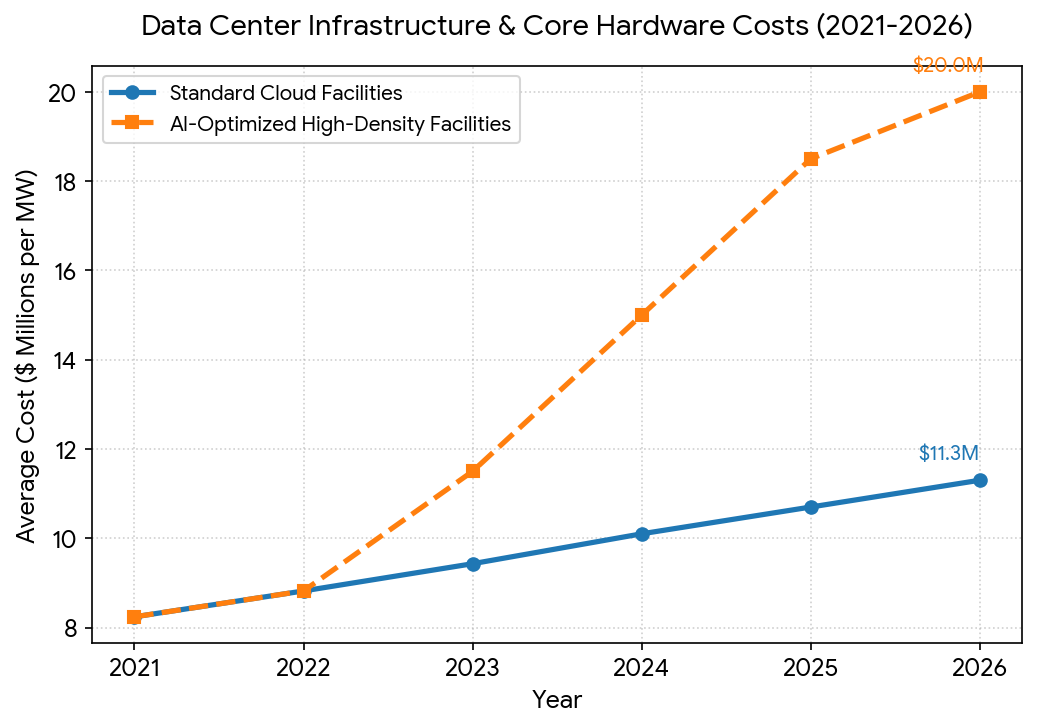
*Source: Data used to create the graph is compiled from leading global real estate, data center construction, and commercial infrastructure indices, including JLL 2026 Global Data Center Outlook, Archdesk 2026 AI Data Center Construction Analysis, Turner & Townsend Data Centre Cost Index and Encor Advisors Data Center Cost Guide
Read more

Industry perspectives: Why 5G Standalone Still Isn’t Universal

Ever since the very first deployment in Korea in April 2019, 5G Standalone (5GSA) has been hailed as the fastest-growing mobile technology in history. Yet global adoption remains far behind expectations. As of March 2026, of a total of approximately 1,400 operators, 95 operators have launched 5GSA. Operators face a complex transition. They’re shifting from legacy architectures to service‑based 5G Cores, adopting new signaling protocols, and embracing cloud‑native operations. All of this is happening while the business case for 5G monetization remains uncertain. One of the many challenges, however, has quietly become one of the big blockers to global 5GSA readiness: the practical deployment requirements of key 5G Core functions. 5G Core readiness: the hidden barrier to 5GSA progress 5GSA only delivers its full value when operators can deploy and integrate the essential 5G Core functions that enable new services, automation, and interconnectivity. Yet despite their importance, many 5G Core functions are designed exclusively for cloud‑native environments. In theory, this aligns with the long‑term vision for 5G. In practice, it creates a structural mismatch: the majority of operators are not cloud‑ready. Industry surveys show that nearly 70% of operators still operate primarily on physical or virtualized infrastructure (Heavy Reading / Omdia 5G Core Operator Survey 2025). Juniper Research similarly notes that fewer than half of operators will deliver cellular services using cloud infrastructure by 2028. The result is a global deadlock: operators cannot activate 5GSA services without key 5G Core functions - but many cannot deploy those functions because they are cloud‑native only. A more realistic path: 5GSA within the operator’s current environment The industry often frames cloud‑native as a destination - but overlooks the journey. Operators vary widely in infrastructure maturity, operational models, and investment cycles. For many, cloud adoption is a multi‑year process, not an immediate step. A sustainable 5G strategy must therefore support:
  • Hybrid deployment models
  • Incremental modernization
  • Reuse of existing infrastructure and skills
  • Avoidance of temporary or duplicate environments
When 5G Core functions require cloud readiness from day one, they introduce unnecessary cost, risk, and delay. Operators face repeated integration cycles, duplicate licensing, and rework when eventually migrating to cloud. These inefficiencies weaken the 5G business case at a time when ROI is already under pressure. Breaking the bottleneck: 5G Core functions without cloud dependency A more pragmatic approach is emerging. It enables key 5G Core functions like SEPP and SCP to run consistently across bare metal, virtual machines, and containers. These functions can even migrate between environments without reconfiguration or downtime. This flexibility fundamentally changes the economics and feasibility of 5GSA rollout:
  • Operators can activate 5GSA services immediately, using the infrastructure they already have.
  • Cloud adoption becomes optional, not mandatory, and can follow the operator’s own timeline.
  • Costs drop significantly, as temporary cloud environments, duplicate engineering work, and parallel licensing are no longer required.
  • Risk is reduced, because operational teams can work within familiar environments.
  • Global readiness improves, especially in regions where cloud maturity lags.
This model levels the playing field. It enables both advanced and emerging markets to participate in 5GSA sooner, strengthening the global ecosystem and accelerating service innovation. This is why we see early indicators in the market: leading operators, IPX providers, and IoT platforms are prioritizing 5G Core solutions that support hybrid deployment models. They recognize that flexibility - not cloud purism - is what will unlock the next phase of 5G growth. Toward a more sustainable 5G future The industry’s long‑term vision for cloud‑native networks remains valid. But insisting on cloud‑native readiness as a prerequisite for 5GSA deployment has slowed progress more than it has accelerated it. A sustainable strategy acknowledges that modernization is a journey, and that operators need solutions designed for every step, not just the end state. By removing cloud dependency from 5G Core deployment, the industry can:
  • Accelerate global 5GSA rollout
  • Reduce deployment costs
  • Improve ROI
  • Expand inclusion across markets
  • And ultimately strengthen the business case for 5G
5G Core functions should be enablers, not barriers. Learn more about BroadForward’s approach to flexible, future‑proof 5G Core deployment For service providers looking to activate 5GSA services without cloud‑related delays or costs, BroadForward offers SEPP and SCP solutions designed to be deployed and operate at every stage of the modernization journey.   Also see: Industry Perspectives: The 5G Service Communication Proxy (SCP) as a core intelligence layer Read: 5G SCP: Evolving as a core intelligence layer Industry perspectives: Adoption of SEPP for 5G roaming Read: The adoption of SEPP for 5G roaming – why It matters and what’s next Read more

BroadForward partners with e& to reinforce secure 5G roaming

Powered by BroadForward’s SEPP, the deployment ensures secure interoperability and robust 5G roaming protection

Barcelona, Spain / Abu Dhabi, UAE – 02 March 2026: e& UAE, the flagship telecom arm of global technology company e&, today announced at Mobile World Congress (MWC) in Barcelona, that it has selected BroadForward’s Security Edge Protection Proxy (SEPP) to enhance the security of its 5G and international roaming capabilities. This decision reflects its commitment to deploying best-in-class solutions to support its advanced mobile network service and continuously enhancing end-to-end integrity and safeguarding its networks against evolving security threats. Implemented in collaboration with Emircom, the deployment supports secure interoperability with roaming partners and strengthens protection against evolving security threats. BroadForward SEPP secures 5G interconnects, ensuring safe and reliable communication between mobile networks. It is software-based, vendor-agnostic, and supports 4G-5G interworking for seamless interoperability and easy integration with existing core networks. Khaled Al Suwaidi, Senior Vice President of Core Network and platform at e& UAE, said: “At e& UAE, we are dedicated to adopting best-in-class technology solutions that reinforce our leadership in the telecommunications industry. The selection of BroadForward SEPP is a strategic decision to enhance the security and efficiency of our 5G roaming and interconnect services. We are confident that this solution, implemented in partnership with Emircom, will provide a strong foundation for our network’s future.” Taco Schoute, CEO of BroadForward, said: “We are incredibly proud to have been selected by e& UAE, and to have successfully delivered the BroadForward SEPP together with our trusted partner Emircom. This achievement marks a significant milestone in enabling secure 5G roaming, and reflects our shared commitment to innovation, flexibility, and world-class mobile security”. This deployment strengthens e& UAE’s roaming security and interconnect capabilities, supporting secure service continuity for customers when travelling internationally.   About e& UAE e& UAE is the flagship telecom arm of e& in the UAE, built on a 5-decades legacy of connectivity excellence. Our mission is to deliver world-class superior connectivity experiences that fuel the UAE’s future-focused innovation. Leveraging the latest world-class technologies, e& UAE aims to transform lives and industries, turning every connection into an opportunity for growth and every interaction into a transformative possibility. We are focused on expanding our core services and digital marketplaces by enriching consumer value propositions that cater to new lifestyles and emerging demands beyond core telecom services, including health, insurance and gaming. As a trusted enterprise partner, e& UAE continues to power entire industries with 5G and AI, delivering a tailored ecosystem of solutions to meet their connectivity needs and more, empowering them to automate, innovate, transform, and scale. Strengthening our leadership position as an AI-powered telco, e& UAE delivers seamless connectivity, cutting-edge AI solutions, and sustainable innovation to uplift people and communities, and empower businesses and industries, so everyone thrives in a digital-first world. To learn more about e& UAE, please visit: https://www.etisalat.ae   About Emircom Emircom is one of the Middle East's leading independent providers of Telecom & IT infrastructure services, helping customers to drive growth and deliver measurable outcomes. Emircom Powered Managed Services offers comprehensive, tailored solutions designed to streamline Telecom operations and enhance business efficiency. For more information, visit: https://www.emircom.com/about/   Also see: Industry perspectives: Adoption of SEPP for 5G roaming Read: The adoption of SEPP for 5G roaming – why It matters and what’s next Arelion Launches Global 5G Roaming Solution with BroadForward Read Arelion announcement on PR Newswire BroadForward’s SEPP goes live in Comfone’s IPX, enabling 5G Standalone Roaming services globally Read: Comfone Launches 5G SA Roaming with BroadForward SEPP BICS announced that it has enabled the “world’s first-ever” intercontinental 5G Standalone (SA) roaming connection Read: BroadForward SEPP enables BICS to execute world's first live 5G SA Roaming connection across borders Read more

BroadForward signaling security portfolio awarded champion status in Kaleido’s Roaming Vendor Hub report

Strengthened scoring criteria and expanded benchmarking underscore BroadForward’s leadership in global roaming signaling security and Firewall solutions Amersfoort, 19 November 2025, Kaleido today announced that the BroadForward signaling security portfolio has been awarded Champion status in the latest Kaleido Roaming Vendor Hub Report, reaffirming the company’s position at the forefront of innovation and excellence in global roaming and interconnect security. This recognizes BroadForward as one of the top-performing vendors in the signaling security category. Kaleido Intelligence’s Roaming Vendor Hub Report is widely regarded as the roaming industry’s most comprehensive and credible competitive intelligence study. The 2025 edition encompasses five months of rigorous research, evaluating 79 vendors and 185 roaming product offerings across 10 service areas. Its findings play a key role in guiding operators as they evaluate partners across an increasingly complex roaming landscape. Within the signaling security category, where 21 providers were assessed in depth, BroadForward’s outstanding performance secured its Champion status despite the heightened difficulty of this year’s scoring framework. Nitin Bas, Chief of Strategy & Insights at Kaleido Intelligence commented; “BroadForward’s ranking stands out as one of the strongest four among the 21 signaling security providers evaluated this year. Achieving Champion status was more difficult than ever due to raised scoring thresholds raised. Yet BroadForward exceeded the new benchmark with a performance that clearly reflects its technical leadership, innovation velocity, and consistent delivery to operators. Their results place them firmly among the most influential players shaping the future of roaming security.” BroadForward’s leadership in signaling security and interconnectivity has been built over years of delivering advanced, software-defined solutions such as DRA, STP, SEPP and multi-protocol signaling firewalls. Its technology is relied upon by many of the world’s most prominent IPX and IoT providers. Also see: Comfone Launches 5G SA Roaming with BroadForward SEPP Wireless Logic deploys BroadForward’s Unified Signaling Core Türk Telekom International chooses BroadForward STP, DRA and Firewalls Arelion Launches Global 5G Roaming Solution with BroadForward Industry perspectives: The Ghost in the machine: Why Telecoms can no longer trust the past BroadForward’s innovation track record also includes nine GSMA nominations for Best Mobile Technology and the highest GSMA recognition for Best Mobile & Network Software Breakthrough and Best Digital Tech Breakthrough. For full details, the Kaleido Roaming Vendor Hub Report is available here About Kaleido Kaleido Intelligence is a specialist research firm focused on mobile roaming, connectivity, and emerging telecom technologies. Recognized for its rigorous methodology and deep market insight, Kaleido provides the industry’s most comprehensive competitive intelligence across roaming, signaling security, IoT connectivity, private networks, and mobile data. Its annual Roaming Vendor Hub Report is widely regarded as the definitive benchmark for evaluating vendor performance, offering unparalleled transparency, detailed product analysis, and independent scoring built on extensive primary research. Kaleido’s insights guide operators, vendors, and ecosystem partners worldwide as they navigate the evolving landscape of global connectivity. Read more

BroadForward expands footprint across Middle East & Africa with strategic STP, DRA, SEPP and Firewall deployments

BroadForward Unified Signaling Core powers seamless STP and DRA replacement as well as 5G roaming and security enablement across multi-operator deployments Amersfoort, The Netherlands - 12 November 2025 - BroadForward today announces a major expansion across the Middle East and Africa (MEA), marked by successful deployments of its mobile core network products with leading operator groups across multiple countries. These wins reinforce BroadForward’s leadership in signaling technology and serve as validation that its mission-critical solutions are increasingly the preferred option for modernizing legacy telecom infrastructure and enabling next-generation connectivity. The expansion comes as the MEA region experiences significant digital transformation, driven by an accelerating shift to advanced mobile technologies. GSMA Intelligence reports that 5G is projected to account for 50% of all mobile subscribers in the region by 2030, underscoring the vital need for robust, modern core network infrastructure to support this demand. In Africa, BroadForward has replaced legacy STP and DRA functionality in multiple networks, supporting operators to transition from aging systems to a fully supported, modern software architecture. In the Middle East, BroadForward has deployed its 5G SEPP solution across several operators, enabling secure and seamless interconnection for 5G roaming. These deployments highlight the strategic importance of continued development in STP and DRA as well as the introduction of SEPP for safeguarding signaling traffic and ensuring interoperability in the 5G era. Taco Schoute, CEO of BroadForward, commented on the achievement: "These wins represent a major milestone for BroadForward and a strong validation of our Unified Signaling Core technology. The Middle East and Africa are regions of immense importance for the global telecom industry, presenting both the challenge of modernizing vast legacy infrastructure and the opportunity of rapid 5G rollouts. Our success here is achieved in collaboration with our local resellers and system integrator partners, and demonstrates our ability to deliver highly flexible, future-proof solutions that meet the diverse needs of the continent's most ambitious operators." BroadForward’s Unified Signaling Core (USC) offers a common signaling architecture and is tailored to enable integration in multi-vendor network environments, making it well suited to support replacement of fragmented legacy systems. As an example, BroadForward’s GSMA award-winning virtualized Signaling Transfer Point (vSTP), which can be deployed on bare metal, virtual machines, or cloud environments, is one of the few modern products capable of replacing aging legacy systems. The USC design provides operators with a flexible, feature-rich signaling environment which allows for uniform operations and provisioning across all BroadForward 2G, 3G, 4G and 5G products. With its Unified Signaling Core, BroadForward continues to set the standard for flexible, future-proof signaling solutions across legacy and next-generation networks. Read more
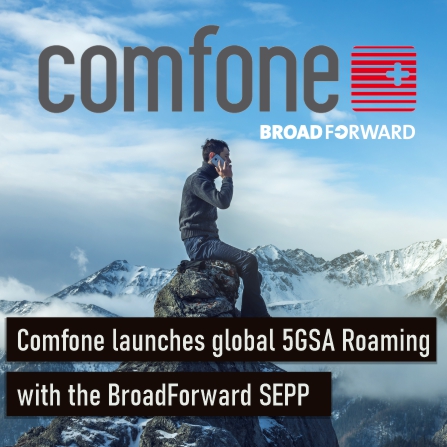
Comfone Launches 5G SA Roaming with BroadForward SEPP

BroadForward’s SEPP goes live in Comfone’s IPX, enabling 5G Standalone Roaming services globally Bern, 20 Oct 2025 – Comfone, a global leader in wholesale mobile roaming interconnect, hubbing, and clearing services, has commercially launched its 5G Standalone (SA) roaming signaling service, powered by BroadForward’s Security Edge Protection Proxy (SEPP). Following a year-long selection process and extensive live trials with two Asian operators, Comfone is now fully operational with live 5G SA roaming, offering mobile operators, MVNOs, and IoT providers scalable, secure, and future-ready roaming solutions. This includes support for GSMA-approved Hosted and Outsourced SEPP Deployment configurations. The BroadForward Security Edge Protection Proxy (SEPP) acts as a gateway that secures and manages all 5G SA roaming signaling, enabling Comfone to provide secure and reliable global connectivity. The BroadForward SEPP runs on the award-winning BFX Unified Signaling Core, a software architecture that supports a range of network functions from 2G to 5G. These include STP, DRA/DEA, SCP, signaling firewalls, and number portability. With a roaming legacy dating back to 1991, Comfone offers a comprehensive suite of IPX interconnect services, including GRX, SS7, Diameter, and HTTP/2 signaling, along with Data and Financial Clearing. The company’s unique centralized Roaming Hub Service, which adheres to GSMA specifications, allows operators to manage all roaming agreements and connections through a single contract connection, handling over 70,000 connections across more than 500 networks. BroadForward is a recognized market leader in signaling innovation, with its software solutions deployed in networks of leading MNOs, MVNOs, IoT connectivity providers, and IPX providers worldwide. Earlier this year, telecommunications market analysts Juniper Research projected that the accelerating rollout of 5G Standalone (SA) technology will be a major catalyst for global wholesale roaming revenue growth, from $9 billion in 2024 to $20 billion by 2028. “This milestone reflects the strength of Comfone’s global capabilities and our commitment to serving more than 600 customers worldwide with a solid and resilient technical infrastructure,” said Daniel Heutschi, CEO of Comfone. “After extensive evaluation and live trials, we chose BroadForward because their BFX product stood out as the most advanced and user-friendly solution. We were equally impressed with their professional collaboration, which has been instrumental in advancing our 5G SA roaming business.” Taco Schoute, CEO of BroadForward, added, "Comfone’s leadership in IPX makes them a natural partner. Our SEPP is well-suited to meet the specific demands of IPX, offering unmatched interoperability, flexibility, and deployment options."   About Comfone Providing borderless and easy communications to all people and all things. From the Key2roam Platform, Comfone offers a complete portfolio of services and solutions to more than 600 customers worldwide. These include MNOs, MVNOs, SMS A2P Providers, IoT/ M2M Solution Providers, OTT Web Service Providers and a range of new actors who wish to enter the roaming world. Furthermore, the Key2roam Platform integrates a complete portfolio of services, apps and Value Added Services (VAS) required to build a profitable roaming business. It is built upon a solid foundation integrating the core IPX, Clearing and Hubbing services, thus enabling the seamless transport of Signalling, Data roaming and Clearing traffic. The data streams flowing from our range of roaming services and VAS create the possibility for powerful Big Data and other cross-analytical tools. https://www.comfone.com/ Read more
Wireless Logic reduces complexity across global networks with BroadForward’s single signaling platform

Award-winning signaling software from BroadForward cuts complexity, streamlines operations and future proofs Wireless Logic’s multi-network infrastructure Amersfoort – September 2, 2025 – BroadForward has extended its strategic partnership with Wireless Logic, a leading global Internet of Things (IoT) solutions provider. BroadForward provides intelligent signaling software that helps Wireless Logic unify and simplify signaling operations across its 2G, 3G, 4G and 5G networks, improving efficiency and strengthening core infrastructure. BroadForward’s Unified Signaling Core (BFX) is already deployed across several Wireless Logic Group companies, including Wireless Logic UK, Webbing and COM4, supporting key functions such as STP, DRA, DEA, SCP and SEPP and signaling firewalls. The platform enables seamless communication across technologies and vendors, allowing Wireless Logic to manage complex deployments with greater consistency and control. Also see: Transforma Insights study identifies market leaders and key trends in IoT connectivity As IoT networks continue to evolve, many operators face mounting infrastructure complexity, with different generations of mobile technology layered across diverse systems and vendors. This increases operational overheads, hinders efficient service delivery and complicates the transition to newer technologies. BroadForward addresses these challenges with its award-winning BFX platform – a flexible software architecture that powers its signaling products. Recognized with a GSMA Award for Best Mobile & Network Software Breakthrough, BFX provides a unified framework that ensures consistent management and operational agility across all network functions and technologies. It also supports deployment on virtual machines, containers or bare metal – adapting easily to different environments. “BroadForward's solutions have already strengthened our signaling capabilities, driving greater operational efficiency,” said James Dennis, Group CTO Mobile Core & Global Network at Wireless Logic. “This extended partnership helps us to future-proof our infrastructure and maintain a clear strategic focus on delivering seamless connectivity to our customers worldwide.” “We’re proud to expand our partnership with the Wireless Logic Group,” said Taco Schoute, CEO of BroadForward. “This partnership highlights the flexibility and depth of the BFX Unified Signaling Core in powering multi-generation networks.” The extended collaboration positions Wireless Logic to continue leading the global IoT space with resilient, secure and scalable connectivity solutions. Also see: Cloud IoT connectivity solution for Roaming, Routing, Security and Interworking   About Wireless Logic Wireless Logic is a global leader in Internet-of-Things (IoT) connectivity, dedicated to bridging the physical and digital worlds with seamless, secure, and scalable solutions. With more than 18 million devices connected across 165 countries and direct partnerships with 50+ mobile and satellite operators, they offer global coverage and end-to-end IoT services which accelerate the success of IoT projects.  Conexa, a purpose-built platform and dedicated IoT network, enables customers to securely connect and manage assets across any network and any number of deployments. This simplifies operations, accelerates time to market, lowers the total cost of ownership, and ensures ultra-reliable connectivity.  Their IoT services are meticulously designed, tested, deployed, and managed to meet the specific needs of each customer device fleet. They strive to deliver the most reliable, flexible, and secure connectivity services in the market.  Wireless Logic's customers range from global enterprises and governments to startups and SMEs, and they operate across a wide range of market sectors, including agriculture, healthcare, manufacturing, security, transport, energy, utilities, and smart cities. Backed by Montagu, a leading mid-market private equity firm, and General Atlantic, a leading global investor, Wireless Logic benefits from unrivalled financial strength and continued investment in growth and innovation.  https://wirelesslogic.com Read more

Industry Perspectives: The 5G Service Communication Proxy (SCP) as a core intelligence layer

Enabling smart, secure signaling in the 5G Core

With nearly 100 standalone 5G Core deployments worldwide, one reality is becoming clear: without intelligent signaling control, scaling 5G will cost operators more than just bandwidth, it could cost them agility. Central to this is the Service Communication Proxy (SCP), a key innovation that takes signaling well beyond the roles played by legacy routing nodes like the STP (SS7) and DRA (Diameter). What is the SCP and why is it important? The SCP is a central intermediary acting as a smart signaling proxy for all service-to-service communication in the 5G Core. Instead of routing messages based on static tables, it dynamically discovers services through the Network Repository Function (NRF) and optimizes communication across distributed Network Functions (NFs) using HTTP/2. Leveraging concepts from cloud-native and IT environments, the SCP provides operators with:
  • Dynamic service discovery and smart routing
  • Built-in load balancing and traffic prioritization
  • Security through mTLS and token-based access
  • Observability with native logging, tracing
  • Network resilience
These capabilities reduce operational overhead, improve robustness, and simplify NF onboarding, which is critical in fast-evolving, multi-vendor 5G environments. How the SCP is evolving like STP and DRA did Just as the STP and DRA emerged to manage increasingly complex signaling in 2G/3G and 4G mobile networks, the SCP is evolving to meet the demands of service-based 5G networks. But it will be relevant in many more ways than its predecessors, as it is a policy-aware, service-oriented controller with advanced roles in:
  • Service authentication and authorization
  • Overload protection and policy enforcement
  • Parameter harmonization across vendors and interfaces where feasible
  • Interworking between legacy (4G) and new (5G) functions
  • Protocol translation, supporting HTTP/2, Diameter, and even SS7
Without the SCP, operators risk a growing complexity and higher signaling costs, as they scale 5G and bridge it with legacy systems. Furthermore, the SCP will likely remain a key signaling hub for 6G as well, as the NGMN announced 6G should be viewed as a seamless evolution – fully compatible with 5G and propelled by continuous software innovation. Understanding SCP Deployment Models For the communication between Network Functions (NF), 3GPP has defined four models (A, B, C and D) encompassing direct and indirect scenarios between a Consumer NF and a Producer NF. In Release 15, 3GPP introduced a direct communication mode between Consumers and Producers NFs. This model of communication does not necessitate any proxy between NFs (no SCP is used). Within this direct mode of communication, there are two distinct options. Model A operates without involving the NRF (Network Repository Function), while Model B utilizes the NRF to handle service discovery and registration processes, maintaining updated records of NF status and their profiles. Indirect communication between NFs was introduced in 3GPP Release 16 to shift discovery and selection responsibilities away from NFs. Here the SCP comes into play, as an intermediary to proxy and mediate signaling between service consumers and producers. The role of the SCP in this architecture is conceptually similar to that of the STP and DRA in 2G/3G and 4G mobile core networks. In Model C, NFs need to communicate with the NRF for service discovery and producer instance or set selection. For the latter, the SCP performs the producer instance selection and load balancing based on the optional NF set discovery parameter included in the HTTP/2 request message from the NFs. Within Model D, the SCP acts as a full-service broker, where all discovery tasks are delegated to the SCP; it communicates with the NRF, applies NF instance selection and load balancing based on real time NRF response data. Put simply, Model C relies on the NF to discover its target via the NRF and uses the SCP solely for routing, whereas in Model D, the SCP manages both discovery and routing on the NF’s behalf. Real-world deployment lessons BroadForward’s initial SCP deployments across various Tier-1 and Tier-2 operators show several recurring realities:
  • Our SCP deployments rarely follow “Model D only” deployment – and our SCP has been deployed to support both Model C and D.
  • Some 5G Core Network Equipment Providers (NEPs) mandate Model D deployment, limiting SCP vendor options as not all support Model D yet.
  • Approximately half of our SCP deployments are initially deployed on Virtual Machines. Many deployments typically start with either VMs or bare metal, offering the option to scale up or transition to the cloud (in containers) later, as and when desired.
  • Not all Network Equipment Providers (NEPs) permit the deployment of third-party network elements within the 5G private clouds they offer with their 5G Cores. Operators should assess if such limitation aligns with their multi-vendor strategy and migration and expansion plans.
  • Integration across technologies is a major aspect of SCP deployments, as coexisting 4G-5G network environments are the norm for the foreseeable future, rather than an exception.
  • Almost all operators require our SCP to perform message manipulation and multi-protocol interworking. A notable recent case involved a national operator using the SCP to extend 4G OCS and PCRF systems into the 5G Core, preserving existing investments while enabling 5G features.
  • In multiple cases operators use our SCP to apply intelligent business logic, for instance to perform external database lookups.
Conclusion: SCP as a core intelligence layer The SCP is not just another signaling router; it’s the evolving intelligence layer of the 5G Core. It enables smart routing, NF discovery, load management, security, and legacy interworking functions that are crucial for vendor interoperability and cost-efficient scaling. BroadForward’s experience shows that the first real-world SCP deployments are far more diverse than the standardization guidelines suggest. This is not unexpected, as we have learned over the decades of network evolution that once new technologies are first deployed, standardization will start to trail vendors’ continuous innovation and adaptation to market realities. Just as the STP and DRA evolved to meet the needs of previous network generations, the SCP is poised for continual advancement. Operators should consider what they need beyond basic compliance. Our experience shows that no two SCP deployments are alike, as each operator faces unique challenges at different stages of their network’s lifecycle. Some may initially need a bare-bones SCP deployment, while others will require the SCP from day one to perform complex multi-technology (legacy) interworking and business logic to enable advanced service scenarios. Interested in reading more about the BroadForward SCP? Click here   Read more

LanceLot Telecom partners with BroadForward to upgrade Core Network signaling

LanceLot picks BroadForward to replace Cisco ITPs with Next-Generation STP for enhanced network performance Utrecht– April 29, 2025 – LanceLot Telecom, a provider of telecommunications solutions, has selected BroadForward to replace its existing Cisco ITP with the BroadForward STP. This transition aims to enhance network performance, improve scalability, and support future telecom developments. BroadForward’s Next-Generation Signaling Transfer Point (NG STP), winner of the 2025 GSMA Global Mobile Award, is an advanced SS7 signaling router designed for modern cloud environments. The solution provides flexibility for handling complex signaling scenarios while meeting evolving industry demands. BroadForward has a track record in innovative mobile network signaling solutions and has received multiple GSMA nominations for Best Mobile Technology. Beyond its expertise in STP replacements across various vendors, the company offers a comprehensive portfolio of advanced signaling solutions, including global deployments of 5G SEPP (Security Edge Protection Proxy) and 5G SCP (Service Communication Proxy). Also see: Rationalizing legacy 2G STP: A necessary step for the future LanceLot Telecom operates its own core network and number ranges across multiple countries, offering customized signaling solutions tailored to client needs. The adoption of BroadForward’s STP aligns with LanceLot Telecom’s strategy to modernize and streamline its signaling infrastructure. “BroadForward was our top choice for this replacement,” said Jeroen Brüggemann, CEO of LanceLot Telecom. “The BroadForward STP is a modern and uniquely flexible software solution that not only strengthens our core network and enhances security but also provides us with more options to optimize our signaling services. BroadForward technology enables us to adapt quickly to new requirements and expand our capabilities with greater agility, ensuring we stay ahead in a rapidly evolving telecom landscape.” The deployment of BroadForward’s STP will enhance LanceLot Telecom’s network services capabilities, reliability and scalability, paving the way for a future transition to a cloud-native architecture. About LanceLot Telecom LanceLot Telecom was established in 2008 and is a licensed operator in multiple countries in Europe and a GSMA Rapporteur member. LanceLot focusses primarily on hybrid fintech solutions within the telecom industry. We own and operate fixed and mobile numbers and are active in many aspects of the digital ecosystem. LanceLot runs it’s own mobile core network and is constantly developing new innovative hybrid services. Our enterprise services include a wide range of communication services and functionalities (SMS, voice, lookups, otp, api) available through multiple integration options. Website: https://www.LanceLot-telecom.nl/   Read more

Türk Telekom International Enhances Network Routing and Security with BroadForward and Odine

Odine deploys BroadForward STP, DRA and signaling Firewalls at TTI Dubai, 8th April 2025. Türk Telekom International (TTI), a prominent provider of internet and IP interconnect services across multiple countries, has announced the successful integration of BroadForward's Signaling Transfer Point (STP) and Diameter Routing Agent (DRA), alongside advanced BroadForward signaling firewall security for 2G, 3G and 4G networks, facilitated by global technology partner Odine. Key to TTI's decision to embrace the BroadForward solution is the unparalleled versatility offered by BroadForward’s 'single engine’ converged signaling solution. This innovative approach allows TTI to support multiple generations of core network functions, providing an array of deployment models as well as unmatched flexibility, efficiency, and convergence advantages. With support for SS7, Diameter, HTTP/2, and more, this software architecture perfectly aligns with TTI's forward-looking vision towards 5G and beyond. Ayhan Yenici, Voice&SMS&IPX Manager of TTI Technology, expressed "The option to uniformly manage and provision systems while achieving virtualization across generations of network functions is pivotal for the efficiency of our operations.” Kemal Kestane, Network Management Director of TTI Technology, added “The inherent flexibility of the BroadForward converged signaling solution perfectly suits our dynamic needs as a fast-moving service provider, especially on the road to providing full 5G roaming support." By adopting the common signaling engine and intuitive GUI management interface of the BroadForward solution, TTI stands to gain significant operational efficiencies and streamlined network management processes. Moreover, this centralized approach also enables TTI to adapt swiftly to evolving industry standards and customer demands. Odine, a trusted partner of BroadForward, has delivered the GSMA GLOMO award-winning signaling solution to TTI, marking a significant milestone in the transformation of TTI's network architecture in preparation for the 5G era. Odine's deep expertise in end-to-end SaaS/PaaS solutions and systems integration played a pivotal role in the successful implementation of the project. Türk Telekom International remains committed to delivering best-in-class services to its customers and partners, with a relentless focus on innovation and technological advancement. The collaboration with BroadForward and Odine underscores TTI's dedication to staying at the forefront of the telecommunications landscape.   About Türk Telekom International (TTI) Türk Telekom International is a leading telecommunication operator in the CEE region, Türkiye, Caucasus, Middle-East and Asia. Türk Telekom International provides a full range of Internet/data services, infrastructure and wholesale voice services to incumbents, alternative carriers, mobile operators, cable TV companies, Internet service providers and corporate customers. Türk Telekom International is 100% owned by Türk Telekom and act as its international business unit handling all international data and wholesale voice business functions. Türk Telekom International provides single account management and unified network operations over the entire Türk Telekom International network which includes 19 countries in Central and Eastern Europe, Türkiye, Middle East and the Caucasus. https://turktelekomint.com/ For further inquiries, please contact Email: info@turktelekomint.com About Odine Odine is a BroadForward partner and reseller. Odine is a global partner empowering sustainable network transformation, building resilient and software-defined networks of the future. We are a leading technology company that enables global companies to evolve with a sustainable approach. With market-leading technology, holistic solutions, and collaborative partnerships, we will support you in reinventing your value creation formula fully dedicated to your success. Our resources are available for organizations to tap into whenever they need them. We work collaboratively to equip you with the power to evolve your business models, build new propositions, differentiate yourselves, and accelerate into new territories. Odine is publicly listed on the Borsa Istanbul (BIST: ODINE), demonstrating our commitment to transparency, accountability, and delivering long-term value to our shareholders. www.odine.com Read more