Bridging the Skies: How Signaling Unlocks the Satellite-to-Mobile Revolution Read newspost
5G Traffic Growth Accelerates as India Closes the Gap with 4G Read newspost
6G Core Debate Raises Familiar Questions About Standards and Evolution Read newspost

BFX Unified Signaling Core (USC)

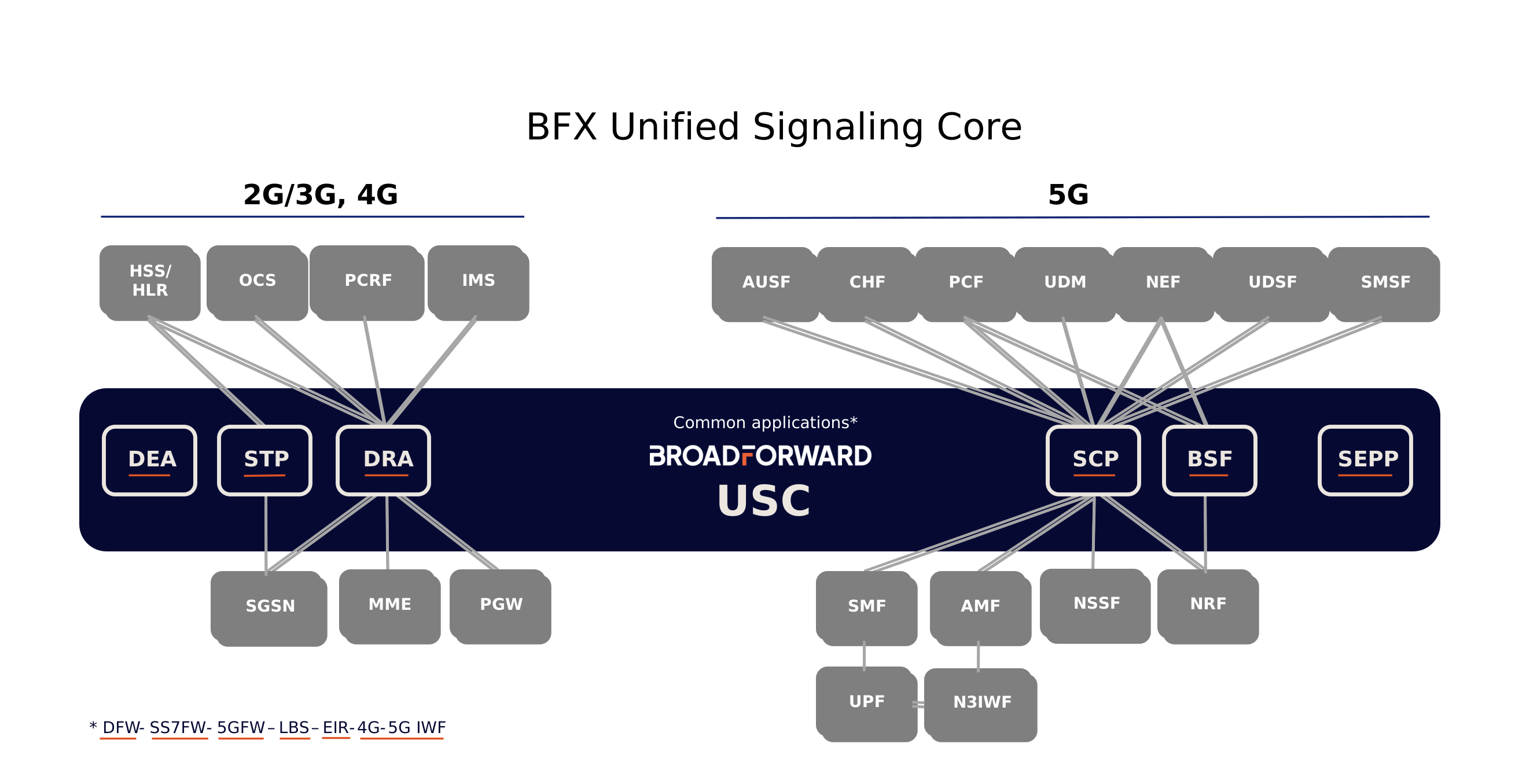
The BFX Unified Signaling Core (USC) is BroadForward’s single software platform, natively unifying SS7, Diameter, HTTP/2, and IT signaling across all mobile generations.

Award graphic for GSMA Global Mobile Awards 2021, with text "Winner Best Mobile & Network Software Breakthrough."

Platform

The Platform Underneath Every BroadForward Product

All BroadForward products – STP, DRA, DEA, SCP, SEPP, BSF, NP, IWF, EIR, and firewall functions – run on the BFX USC platform, provisioned and managed through a common GUI or CLI. Operators configure signaling scenarios and anomaly handling independently; no coding required, and functions simply unlock by license.

BFX USC, winner of the GSMA GLOMO Award for Best Mobile & Network Software Breakthrough, provides an any‑to‑any signaling engine spanning 2G/3G (SS7), 4G (Diameter), 5G (HTTP/2), Fixed/Wi‑Fi (RADIUS), and IT protocols such as SOAP, REST, LDAP, and ENUM – deployable on virtual machines, containers, or bare metal.

BroadForward BFX USC

BFX hub

One Platform, Every Generation

Many operators must keep legacy core functions running even as they migrate to newer generations – often for decades – due to service continuity, regulatory obligations, and long‑term contracts. Interconnect providers face the same reality, globally supporting multiple mobile generations from multiple vendors in parallel.

The BFX USC is built for this multi‑generation environment: a single converged software architecture that natively handles SS7, Diameter, RADIUS, HTTP/2, and IT protocols side by side – without forcing operators to maintain separate boxes, separate product knowledge, or obsolete licenses.

BroadForward USC unifies its 2G–5G product portfolio under a single management GUI, ensuring operational consistency across all network generations. This common interface significantly reduces operational complexity while speeding up daily operations, troubleshooting, and service adaptation across all signaling functions.

MNOs, MVNOs, IPX, NTN, and IoT providers in production
0 +
Platform for every signaling generation
0
Lines of code or scripting required
0

Trusted by

liberty-global
2DEGREES
AIRALO
ALIANZA
ARELION
ATOS
BICS
CELLUSYS
CGI
CIRRUS
CLARO
COMFONE
DIGICEL
DOCOMO
EMIRCOM
ENGHOUSE
ETISALAT
IBASIS
ICONECTIV TNS
LEBARA
M1
MOBIFONE
MODULO
MTN BYOBAB
NGVOICE
NOMIOS
NSSOL
NTT
ODINE
ORANGE
POLKOMTEL
PROXIMUS
SAMSUNG
TATA
TELENET
TELKOMSEL
TELMEX
TERRESTAR
TURK TELEKOM INTL
UNITEL
VODAFONE

Not all operators running 2G through 5G get to retire what came before.

What it does

What operators get out of one platform.

Unified signaling functions

Runs routing, security, interworking, number portability, and storage functions – including STP, DRA, DEA, SCP, SEPP, BSF, signaling firewalls, EIR, Location (GMLC, LRF, RDF), NP, and ENUM – on a common signaling platform, licensed by capacity, function, and protocols used.

Common GUI/CLI operations

Every onboard function is configured, adapted, and monitored through the same GUI or CLI. Operators independently define signaling scenarios and anomaly handling without coding or scripting.

Cloud ready legacy migration 

Fully virtualized, containerized, and cloud ready – including legacy 2G/3G functions, unlike hardware bound STP/DRA appliances. Enables operators to replace and relocate legacy STPs and DRAs into cloud based data centers (VM or CNF).

Consistent deployment model

Every product supports the same deployment, configuration, and provisioning model, eliminating the need to relearn operations for each network generation or newly licensed function.

Hardware agnostic software

100% software based and hardware independent: bare metal, virtual machines, containers, or cloud.

Why it matters

Immediate impact

Operator self sufficiency

Signaling scenarios and anomaly handling are typically adapted by the operator’s own teams through the GUI/CLI, rather than through vendor tickets.

Lower TCO

Consolidates what used to be five or six separate platforms into one, reducing hardware footprint, licensing overhead, and retraining time.

No forced migration

Operators can invest in 5G and beyond while keeping legacy revenue generating functions running on their own timeline.

Proven at scale

BFX USC is in production at 100+ MNOs, MVNOs, IPX, NTN, MNP, and IoT connectivity providers worldwide, running 2G–5G network functions.

Faster time to market

New licensed functions deploy on existing infrastructure with a common, familiar GUI.

Search

Change language