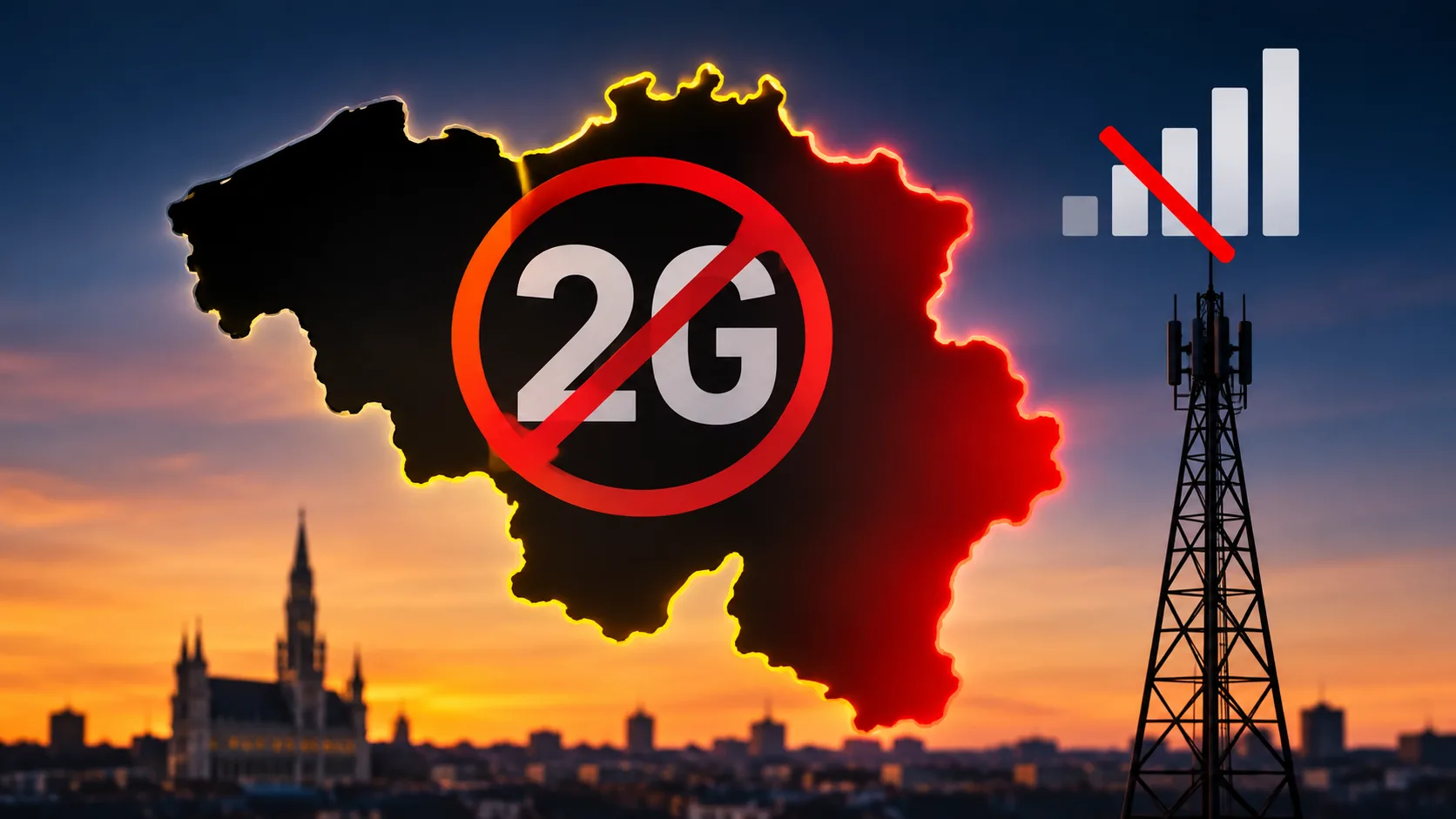
Belgium’s mobile operators are preparing to retire their legacy 2G networks, with Orange Belgium, Proximus and Telenet/BASE confirming plans to phase out the technology between 2028 and 2029. The announcement, confirmed by the Belgian Institute for Postal Services and Telecommunications (BIPT) on November 16, 2026, marks another milestone in the country’s transition towards modern mobile network infrastructure.
Legacy Network Sunset
Reallocating Spectrum for 4G and 5G
Following the completion of Belgium’s 3G network switch-offs in 2025, operators are now preparing to phase out 2G after more than three decades of service.
Retiring legacy infrastructure will free up valuable spectrum resources for 4G and 5G, enabling operators to increase network capacity, improve service performance and operate their networks more efficiently.
Each operator is following its own migration schedule. Orange Belgium plans to switch off its 2G network starting January 1, 2029, while Proximus has announced July 1, 2029 as its discontinuation date. Telenet/BASE has also confirmed its intention to phase out 2G within the 2028–2029 timeframe.
Although the timing differs between operators, the direction is clear: legacy mobile infrastructure is gradually giving way to more advanced, spectrum-efficient network technologies.
Addressing Voice Fallback and IoT Dependencies
While Belgium’s extensive 4G and 5G coverage limits the overall risk of widespread coverage disruption, the transition will affect devices and applications that still depend on 2G connectivity.
Beyond older mobile handsets, this includes numerous machine-to-machine (M2M) and Internet of Things (IoT) deployments, such as smart meters, alarm systems, elevator emergency lines, payment terminals and automotive eCall systems.
There are also potential implications for newer 4G and 5G smartphones that do not support Voice over LTE (VoLTE), or are not properly configured for it. Some devices may still depend on legacy network access for voice services or emergency calling. Ensuring compatibility with voice and emergency services over 4G will therefore be an important part of the migration process.
For enterprises, the challenge extends beyond replacing individual devices. Migration may also require reviewing embedded modems, SIM and connectivity profiles, network coverage, application compatibility and the operational requirements of systems that depend on continuous connectivity.
This makes early planning particularly important for businesses operating distributed IoT and M2M deployments, where device replacement or connectivity changes can involve substantial operational coordination.
Preparing Today’s Networks for Multi-Generation Transitions
Retiring legacy radio access networks does not happen in isolation. Operators must continue managing multiple generations of signaling infrastructure while migrating subscribers, services and enterprise IoT traffic without disrupting connectivity.
This makes flexible, multi-generation signaling and interworking capabilities an important part of network modernization. Solutions that support legacy and modern protocols within a common architecture enable operators to simplify network operations, manage interoperability and maintain service continuity throughout technology transitions.
The challenge is not simply switching off an older radio technology. Operators must also consider the signaling infrastructure, routing relationships and interconnected network functions that support services across different generations.
Also read: The Future Of The STP
This is where BroadForward has a relevant role to play.
A Unified Signaling Foundation for Network Evolution
BroadForward’s BFX Unified Signaling Core (USC) brings together signaling, routing, interworking and security capabilities across multiple network generations within a common software platform.
Supporting SS7 for 2G/3G, Diameter for 4G and HTTP/2 for 5G Service-Based Architecture (SBA), BFX enables operators to manage different signaling environments within a converged architecture.
This approach offers several advantages during network modernization:
- Multi-generation signaling: Support for legacy and modern signaling protocols within a common software environment.
- Routing and interworking: Flexible signaling control and protocol interworking to support coexistence between different network generations.
- Operational consistency: Centralized configuration and management across multiple signaling functions.
- Flexible deployment: Software-based deployment across bare-metal infrastructure, virtual machines and containers.
- Security and control: Integrated signaling security capabilities to help protect network infrastructure and signaling traffic.
By consolidating multiple signaling functions on a common platform, BroadForward helps operators reduce architectural complexity and modernize legacy signaling infrastructure without requiring an immediate, wholesale transition to a new network architecture.
As the industry moves beyond 2G and 3G towards 5G Standalone and future network architectures, a unified signaling foundation provides the flexibility to manage today’s transitions while preparing for tomorrow’s requirements.
Belgium’s 2G sunset is another reminder that network modernization is an ongoing process. Operators need to maintain interoperability across existing infrastructure while progressively adopting new technologies. Flexible, multi-generation signaling capabilities are an important part of making that transition manageable, efficient and sustainable.