5G Usage Moves from Early Adoption to Mainstream Scale
India’s mobile market has entered a new phase, with 5G rapidly catching up to 4G in terms of traffic contribution. According to recent industry data, 5G data usage surged 88% year-on-year to 107,384 PB, helping push total mobile data traffic to a record level. While 4G remains the dominant access technology, the growth rate shows that 5G is moving beyond coverage-driven deployment and becoming a significant traffic carrier in its own right.
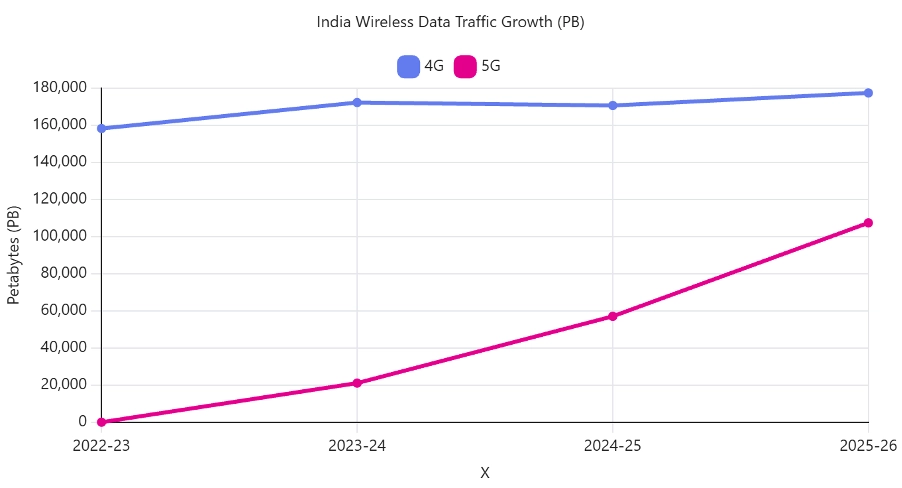
5G Closing the Gap with 4G
India’s wireless data market is undergoing a rapid generational shift. While 4G still carries 62.15% of total mobile data traffic (177,375 PB), 5G has already reached 37.63% (107,384 PB) after growing 88.3% year-on-year. By comparison, 4G traffic increased by just 4.0% over the same period. The figures show that most new mobile data growth in India is now being driven by 5G, which has expanded from 11% of wireless data traffic in 2023-24 to 38% in 2025-26, steadily narrowing the gap with LTE.
The trend is supported by data from the Telecom Regulatory Authority of India (TRAI), which highlights continued growth in broadband subscriptions, smartphone penetration, and mobile data consumption across the country. As operators expand standalone 5G networks and increase population coverage, more traffic is gradually shifting from legacy generations onto 5G, narrowing a gap that until recently appeared much larger.
What the Numbers Mean for Operators
For consumers, increased 5G traffic mainly means faster speeds and improved user experience. For operators, however, the implications are far broader. Every additional petabyte of traffic increases signaling transactions, policy enforcement requirements, roaming interactions, and security exposure across the mobile core.
The transition is not a simple migration from one generation to another. Most operators continue to operate 2G, 3G, 4G and 5G simultaneously, creating a complex multi-generation environment where signaling, routing, policy control and security must work seamlessly across technologies.
As 5G traffic volumes accelerate, operators increasingly need infrastructure capable of managing interactions between legacy signaling protocols such as SS7 and Diameter as well as modern 5G Service-Based Architecture (SBA) interfaces based on HTTP/2.
The Network Modernization Opportunity
This is where network signaling transformation becomes increasingly important. BroadForward is active across 2G/3G, 4G and 5G domains, reflecting the reality that older generations remain critical even as 5G adoption rises.
In legacy networks, operators continue to invest in STP replacements and SS7 Firewall deployments to modernize signaling infrastructure and strengthen protection against interconnect threats. In 4G networks, ongoing projects include DRA replacements and Diameter Firewall installations, driven by growing LTE traffic and the need for more intelligent routing and security.
Meanwhile, the growth of 5G Standalone is creating demand for SEPP (Security Edge Protection Proxy) to secure inter-operator roaming connections. Increasingly, operators are also deploying SCP (Service Communication Proxy) and 5G Firewalls as Service-Based Architecture environments scale and network functions that generate growing levels of API-driven signaling traffic.
A Market Defined by Multi-Generation Growth
India’s latest traffic figures demonstrate that 5G is no longer merely a future investment story. As usage accelerates and the gap with 4G continues to narrow, operators must manage growth across multiple generations simultaneously rather than replacing one network with another.
The result is a growing need for converged signaling, routing and security platforms capable of supporting legacy and next-generation networks from a single operational framework. As 5G traffic catches up with 4G, intelligent signaling and security infrastructure is becoming just as important as radio coverage in enabling the next phase of mobile network growth.
Key takeaway
- 4G traffic is still growing, but only modestly (+4% in FY2025-26).
- 5G traffic almost doubled (+88%) to 107,384 PB and now represents 37.6% of all wireless data traffic in India.