The transition to quantum-safe mobile networks is moving from theoretical research toward practical implementation. On November 18, ATIS released a new post-quantum cryptography (PQC) migration playbook for telecom operators, building on several years of GSMA work covering quantum-safe roaming, hybrid key exchange, and telecom security.
The urgency was reinforced just a day earlier, when Telia Finland, Nokia, and QMill demonstrated quantum-enhanced encryption in a 5G network using commercial equipment.
For mobile network operators, the message is clear: cryptographically relevant quantum computers may still be some years away, but the need to prepare for their impact on network security is already here.
The challenge extends beyond radio and transport-layer encryption. Operators must also consider the long-term security of signaling interconnects, roaming relationships, and the cryptographic infrastructure connecting multiple generations of mobile networks.
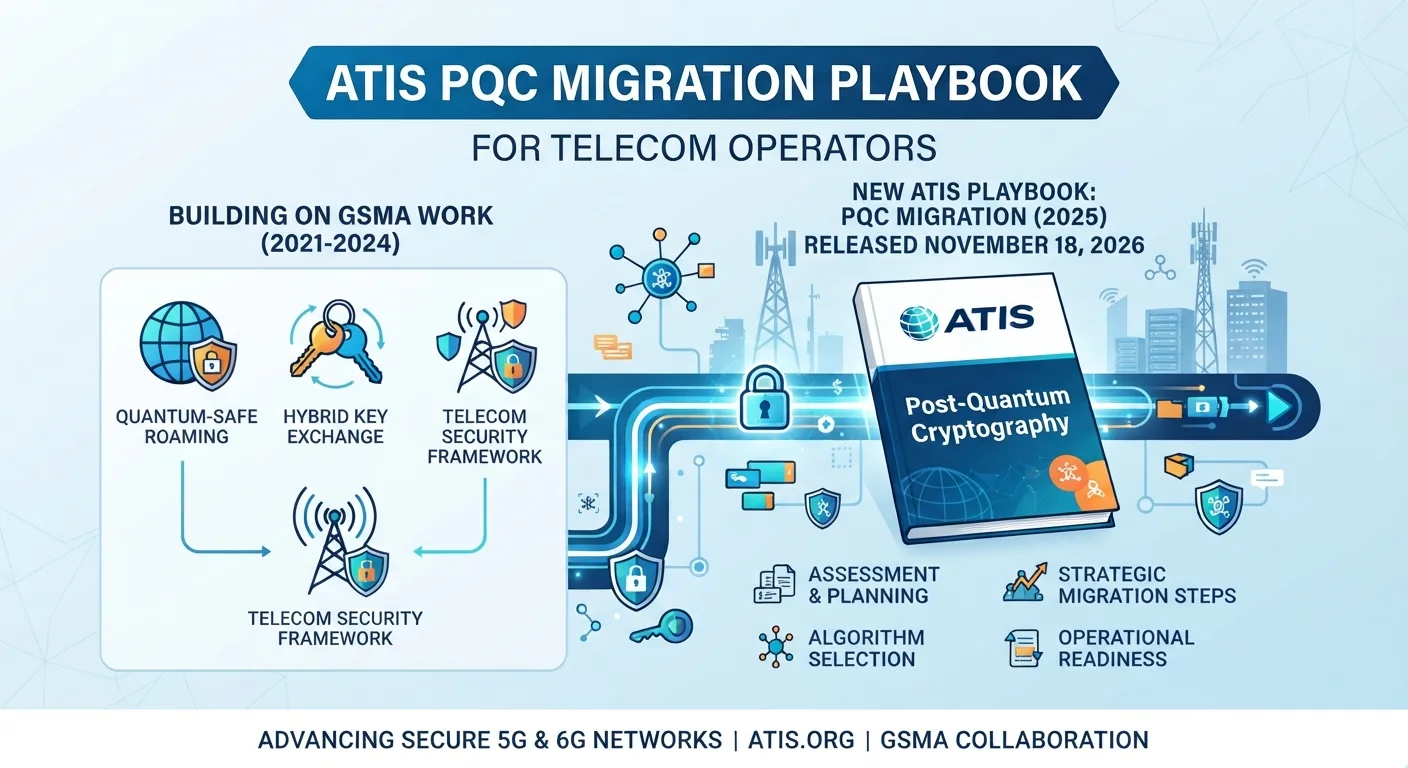
What is Post-quantum cryptography (PQC)?
Post-quantum cryptography (PQC) refers to a new generation of cryptographic algorithms designed to protect digital communications against attacks from future quantum computers. Unlike today’s widely used public-key encryption methods, such as RSA and elliptic-curve cryptography (ECC), which could be broken by sufficiently powerful quantum computers, PQC algorithms are designed to resist both conventional and quantum-based attacks. For telecom operators, this means preparing network infrastructure, signaling interfaces, roaming connections, and authentication systems for a future in which existing cryptographic protections may no longer be sufficient.
Why Signaling Interconnects Are a Critical Part of the Quantum Security Challenge
A central theme of the new ATIS 5G PQC playbook is the threat of “harvest-now, decrypt-later” (HNDL) attacks. Adversaries do not need a fully realized quantum computer today to compromise sensitive telecom data. They can intercept and store encrypted traffic now, waiting until sufficiently powerful quantum computers become available to decrypt information protected by vulnerable public-key cryptography.
The principal quantum threat concerns asymmetric cryptographic mechanisms such as RSA and elliptic-curve cryptography (ECC), which underpin key establishment, digital signatures, and authentication. Symmetric encryption, such as AES, faces a different and generally less severe quantum threat.
While much of the industry conversation focuses on radio and transport-layer encryption, signaling interconnects deserve particular attention. They connect independently managed networks, cross multiple security domains, and involve complex dependencies between different technologies and vendors.
Three areas stand out:
- International Roaming Boundaries: International roaming depends on secure exchanges between home and visited networks. In 5G Standalone, Security Edge Protection Proxies (SEPPs) protect inter-PLMN signaling, including sensitive information exchanged across roaming interfaces. The cryptographic mechanisms underpinning this protection will need to evolve as quantum-resistant standards are introduced. Legacy 4G Diameter and 2G/3G SS7 environments also require attention.
- Cross-Generational Exposure: Most operators run hybrid environments in which 5G Standalone coexists with legacy 4G Diameter and 2G/3G SS7 interconnects. Each generation introduces different security mechanisms, dependencies, and migration requirements. Upgrading one part of the network does not automatically protect the others or their interworking interfaces.
- Long-Term Security and Trust: Long-lived confidential subscriber and enterprise data, cryptographic keys, certificates, and authentication infrastructure require particular attention. Operators must consider not only future decryption risks but also the potential impact of quantum computing on digital signatures, certificates, and the trust mechanisms underpinning network security.
From Cryptographic Inventory to Practical Migration
Both ATIS and the GSMA emphasize that migrating to quantum-safe cryptography cannot be treated as a single rip-and-replace exercise. Operators cannot simply upgrade their cryptographic infrastructure without considering roaming partners, network dependencies, interoperability, and service continuity.
Instead, the industry is moving toward phased, risk-based, and crypto-agile modernization.
Three priorities are emerging:
1. Cryptographic Inventory
Operators must identify where classical asymmetric encryption, including RSA and ECC, is currently used across their core network, signaling nodes, proxies, gateways, certificates, and trust infrastructure. Developing a Cryptographic Bill of Materials (CBOM) provides visibility into these dependencies and helps establish migration priorities.
2. Prioritizing Critical Network Boundaries
Operators should assess the cryptographic exposure of their interconnects, including SEPP-protected 5G roaming interfaces and legacy Diameter/SS7 boundaries. These are important migration points because they connect independently managed networks and involve multiple vendors, security domains, and trust relationships.
3. Controlled Interconnect Pilots
Testing hybrid classical/PQC key exchange in controlled environments and agreed roaming scenarios allows operators to assess latency, packet-size overhead, interoperability, and operational implications before wider deployment. Successful migration will require coordination between both ends of the connection, including their cryptographic implementations, certificates, and key-management capabilities.
The Role of a Software-Driven, Quantum-Ready Signaling Core
Transitioning to post-quantum security requires more than replacing cryptographic algorithms. Operators must evolve security across multiple network generations, protocols, vendors, and interconnect environments without disrupting existing services.
This makes architectural flexibility increasingly important. Hardware-dependent, monolithic solutions can complicate the introduction of new security capabilities, particularly when operators need to maintain interoperability with partners migrating at different speeds.
A unified, software-based signaling architecture such as BroadForward’s BFX Unified Signaling Core provides a flexible foundation for this evolution. By consolidating multiple signaling generations and protocols within a common software framework, it enables operators to modernize signaling infrastructure, adapt interworking and security policies, and evolve network boundaries without separate hardware replacement projects for every technology generation.
Looking ahead, BroadForward will adopt post-quantum cryptography capabilities in BFX, supporting operators as they prepare their signaling infrastructure for the next generation of cryptographic security. Combined with its unified, multi-protocol architecture, this will help address the challenge of evolving security across legacy and next-generation networks while maintaining interoperability.
Quantum readiness is ultimately a network-wide undertaking. Preparing signaling infrastructure today, while building in support for tomorrow’s cryptographic standards, will be an important part of that transition.
The quantum transition is approaching. Operators that modernize their signaling foundations today will be better positioned to adopt tomorrow’s cryptographic standards without having to rethink their network architecture.