Satellite connectivity is becoming an increasingly important part of the mobile industry’s efforts to extend coverage beyond the reach of terrestrial networks. Rather than simply replacing cellular infrastructure, the emerging model combines satellites, ground-based radio access, mobile core networks and interconnection systems. The challenge is to make these different components work together securely and reliably.
Recent developments illustrate two sides of this evolution: satellite operators are expanding their direct-to-device (D2D) ambitions, while established mobile infrastructure remains important for capacity, coverage and network integration. For the industry, the opportunity lies not in choosing between satellite and terrestrial connectivity, but in determining how best to combine them.
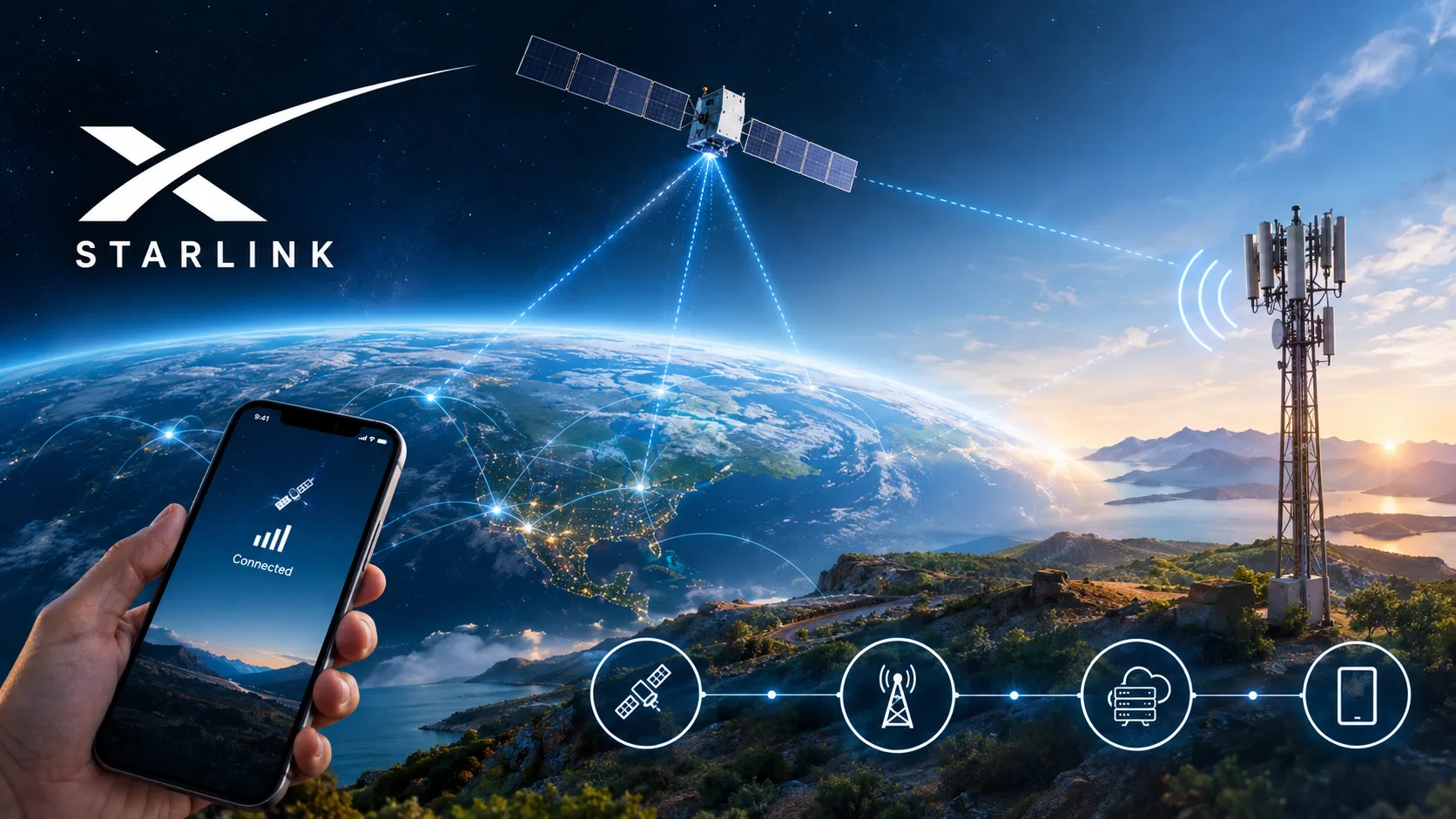
Starlink’s terrestrial ambitions
SpaceX’s strategy illustrates why satellite connectivity and terrestrial infrastructure should not be viewed as competing technologies in isolation.
On October 22, 2026, Bloomberg reported that SpaceX was seeking access to at least 80,000 cell sites across the United States and was in discussions with major infrastructure providers, including Crown Castle. The reported ambition is to support a broader nationwide wireless network, potentially positioning SpaceX as an additional competitor to established US mobile operators. The discussions do not, by themselves, establish that the proposed sites will all be secured or that a nationwide service will follow on a particular timetable. Source: Bloomberg.
This reported initiative should be distinguished from Starlink’s direct-to-cell satellite services. Direct-to-device connectivity uses satellites to communicate with compatible devices or provide access through partner mobile networks, depending on the service and device capabilities. A terrestrial network, meanwhile, can provide additional capacity and conventional cellular coverage in locations where ground infrastructure is viable.
The two approaches can complement one another, but their economics and technical requirements differ. Satellite links can extend coverage over remote areas where building terrestrial infrastructure is difficult or uneconomic. Cell sites can provide greater capacity in populated areas, while also supporting the radio and transport infrastructure needed for a conventional mobile service.
The longer-term competitive implications remain uncertain. Spectrum availability, regulatory approvals, investment requirements, device compatibility and the ability to deliver reliable capacity at scale will all influence how far satellite operators expand into traditional mobile services.
Understanding the different NTN technologies
Non-Terrestrial Networks (NTN) encompass satellite-based network access and related architectures. Within 3GPP standardization, two important technology families support different use cases:
- IoT-NTN: Based on technologies including NB-IoT and LTE-M/eMTC, this approach targets applications such as remote monitoring, asset tracking and industrial sensing. It is particularly relevant where devices need relatively low data rates, low power consumption or connectivity beyond terrestrial coverage.
- NR-NTN: Extends the 5G New Radio technology family to non-terrestrial access. Its potential applications include broadband and other mobile services, subject to the satellite system, spectrum, device capabilities and service implementation.
These are not interchangeable technologies, nor do all satellite-to-mobile services provide the same capabilities. Some focus on narrowband IoT; others support messaging or emergency communications, while more advanced architectures aim to deliver broader mobile connectivity.
3GPP Release 17 established important foundations for both NR-NTN and IoT-NTN. Subsequent development continues to address interoperability, mobility and the practical integration of terrestrial and non-terrestrial access. Sources: 3GPP and GSMA.
Commercial deployment will depend on more than the radio link. Operators must also address subscriber management, authentication, routing, roaming, security and service continuity across networks that may be operated by different organizations.
For terrestrial mobile operators, satellite connectivity can extend the reach of existing services and provide additional coverage options. At the same time, direct-to-device services and spectrum-sharing proposals raise legitimate questions about interference, spectrum rights, network quality and competitive positioning. The balance between cooperation and competition will vary by market and business model.
Why signaling matters
Connecting satellite and terrestrial networks requires more than establishing a radio connection between a satellite and a device. Signaling systems must support the control-plane communication that allows networks to identify destinations, exchange relevant information, apply security policies and route traffic between network domains.
The exact requirements depend on the architecture. Existing 4G deployments may rely on Diameter-based signaling, while 5G Standalone networks use service-based interfaces based on HTTP/2. Legacy SS7 signaling can remain relevant where operators continue to support earlier generations of mobile technology.
This creates a multi-generational integration challenge. Satellite operators, mobile network operators, IPX providers and IoT connectivity platforms may need to exchange signaling across different protocols and network environments while maintaining security and operational control.
A unified signaling platform can help simplify this complexity by providing common routing, interworking and security functions across supported protocols. It does not eliminate the need for standards compliance, network-specific integration or appropriate radio and core-network functionality. Instead, it provides a foundation for managing the interfaces between systems.
BroadForward’s role in satellite–terrestrial integration
BroadForward’s work with Terrestar Solutions provides a concrete example of signaling technology being applied to satellite-to-mobile connectivity.
On October 13, 2026, we announced that our Diameter Routing Agent/Diameter Edge Agent (DRA/DEA) routing and Diameter Firewall solutions had gone live in Terrestar’s network. The deployment supports secure, standards-based signaling between Terrestar’s satellite infrastructure and terrestrial mobile networks, helping enable mobile and IoT connectivity in areas with limited or no terrestrial coverage.
The announcement also describes Terrestar’s wider plans for hybrid satellite-cellular services, including industrial and agricultural IoT applications and a roadmap for consumer messaging and emergency alerts. These services and planned developments should be distinguished from one another: the live signaling deployment is established, while individual future service capabilities depend on their respective implementation and rollout.
At the core of BroadForward’s portfolio is the BFX Unified Signaling Core (USC), a software platform supporting signaling functions across multiple generations of mobile technology. Its supported protocols include SS7 for 2G/3G, Diameter for 4G, and HTTP/2 for relevant 5G service-based interfaces. The platform also supports functions for routing, interworking and signaling security, with deployment options that include virtual machines, containers and bare-metal infrastructure. R
For operators managing legacy networks alongside newer services, this approach can reduce the need to maintain separate signaling platforms for every technology generation. It can also provide a common operational framework as networks evolve. In satellite-related deployments, the specific functions required depend on the interfaces and protocols used by the participating networks; support for multiple generations should not be interpreted as automatic compatibility with every NTN architecture.
BroadForward servers a wide customer ecosystem which includes mobile operators, Network Equipment Providers, IPX/IoT/NTN Connectivity providers.
A complementary future for satellite and terrestrial networks
The evolution of mobile connectivity is unlikely to follow a single path. Satellite services can extend reach, support remote IoT applications and provide connectivity where terrestrial coverage is unavailable. Terrestrial networks will continue to play a central role in delivering capacity and consistent service in populated areas. Hybrid architectures can bring these strengths together, provided that their technical, commercial and regulatory requirements are addressed.
For the signaling industry, this creates a practical challenge: ensuring that different network domains can exchange traffic securely and efficiently without adding unnecessary operational complexity.