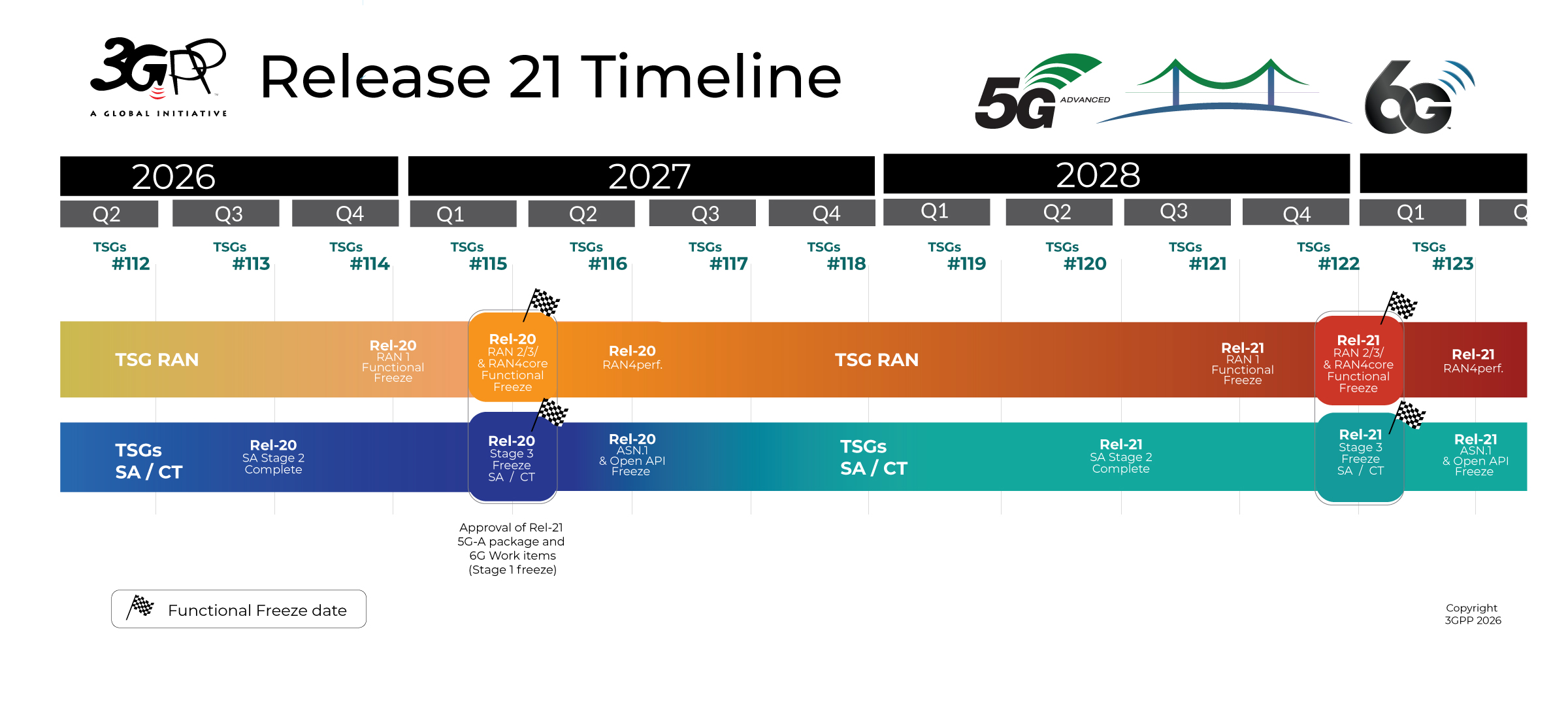
At recent 3GPP plenary meetings in Madrid, standards delegates postponed key architectural decisions regarding 5G-to-6G migration until December, aiming to reach consensus and avoid expensive past mistakes.
While Multi-Radio Access Technology Spectrum Sharing (MRSS) has been established as the baseline mechanism for spectrum sharing between 5G and 6G, intense debate remains over whether additional migration options should be standardized at all.
Operators and industry bodies like the NGMN Alliance strongly advocate for keeping 6G migration as simple as possible. The hesitation to approve extra options stems from painful lessons learned during the 4G-to-5G evolution, where excessive choices led to network fragmentation, prolonged rollouts, costly retrofits, and multi-billion-dollar inefficiencies.
As operators migrate from 5G NSA to 5G Standalone (SA)—and prepare for future generations—they face severe operational hurdles:
-
Protocol Fragmentation: Operators are forced to run legacy signaling protocols (SS7 and Diameter) alongside 5G’s modern HTTP/2 Service-Based Architecture (SBA) APIs.
-
Control Plane Complexity: Managing dual connectivity requires constant cross-generation handovers, synchronized subscriber databases, and parallel core maintenance.
-
High Technical Debt: Carried-forward architectural compromises from NSA delay the deployment of native 5G SA features like end-to-end network slicing and advanced policy management.
-
Model B (6G-Anchored Dual Connectivity): Anchors connections in the new target core while maintaining dual connectivity with 5G radio access. While it drives core evolution, it forces complex session anchoring and heavy signaling loads back onto legacy access nodes.
-
Model C (5G-Anchored Dual Connectivity): Functions similarly to the initial 5G NSA deployment by anchoring 6G connections in an existing 5G core. This model has virtually no industry backing because it repeats the exact NSA mistake—trapping operators in legacy dependencies and delaying access to native 6G features.
-
Model D (Dual-Stack / Dual-Registration): Keeps devices registered across both core generations simultaneously. This generates massive signaling spikes, synchronization friction between subscriber database nodes (such as HSS and UDM), and severe signaling channel congestion.
This is where the BroadForward BFX Unified Signaling Core (USC) is uniquely positioned:
-
Multi-Generational Convergence: BFX USC acts as an independent central interworking engine, providing seamless translation across legacy protocols (SS7, Diameter, RADIUS) and modern 5G HTTP/2 SBA interfaces.
-
Decoupled Architecture: By handling routing, interworking, and security centrally at the signaling plane, BFX decouples core network evolution from radio access choices, mitigating the operational friction of Models C, and D.
-
Unified Routing & Protection: Combines STP (2G/3G), DRA (4G), SCP (5G), and cross-generation signaling firewalls within a single software environment, eliminating vendor lock-in and reducing integration touchpoints.