The Emerging Threat of Autonomous Edge AI
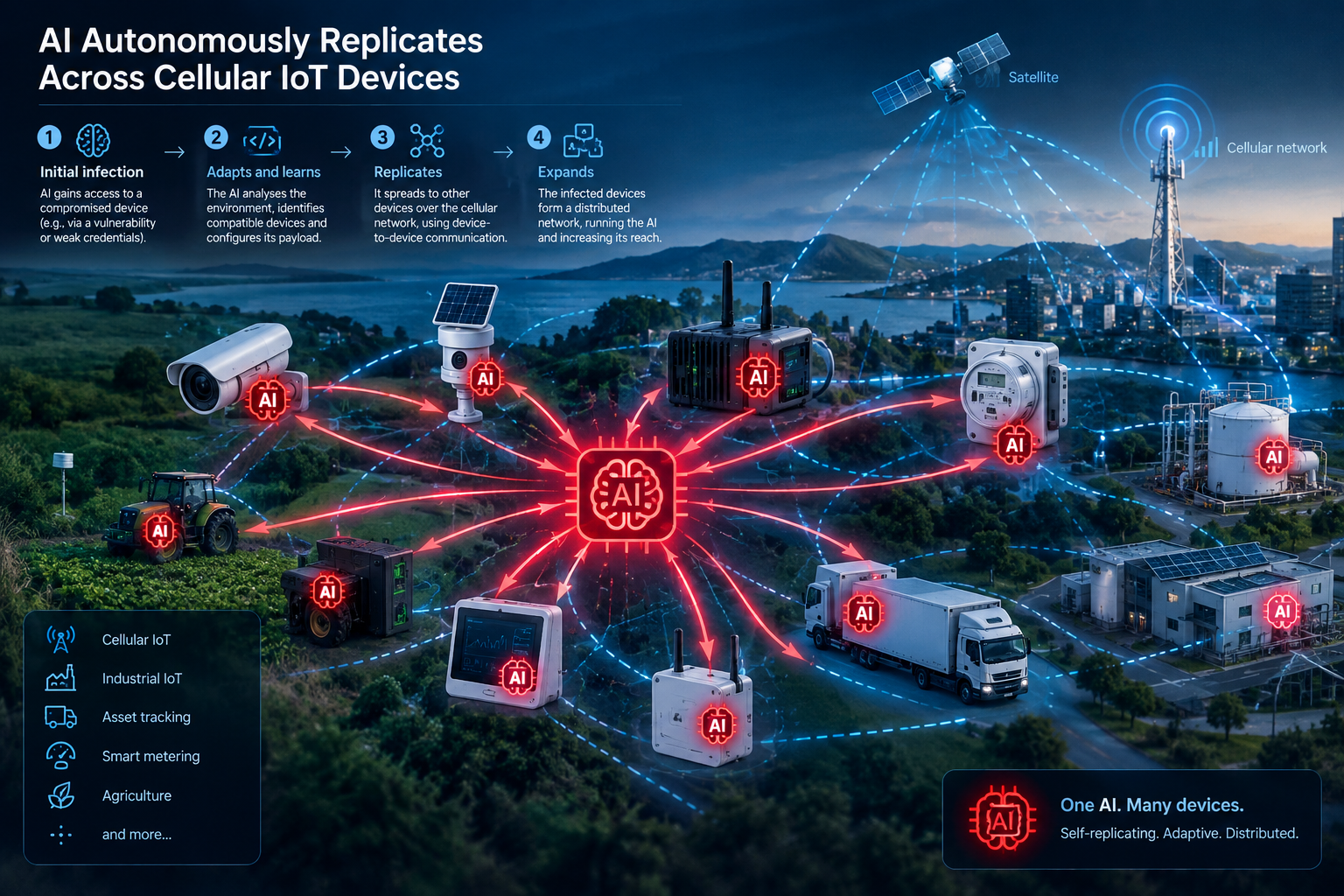
Research published by Anthropic’s Frontier Red Team highlights a potential new challenge for IoT cybersecurity: the emergence of AI-enabled malware capable of adapting to unfamiliar hardware and potentially replicating across networks of compromised edge devices.
In its October 2026 research, Anthropic demonstrated that a 26-billion-parameter open-weight AI model could distribute its inference workload across 15 inexpensive Android TV boxes costing approximately US$55 each. In separate controlled experiments, researchers demonstrated an AI agent completing an end-to-end replication process across a simplified network of virtual Android devices.
These experiments do not demonstrate a fully autonomous worm spreading across real-world IoT networks. They do, however, illustrate important building blocks for a potential new generation of adaptive malware.
Unlike conventional malware that depends primarily on predefined instructions and known device configurations, AI-enabled malware could use autonomous reasoning and coding capabilities to adapt deployment methods to unfamiliar hardware and software environments. Anthropic also found that passing notes about earlier attempts to subsequent AI agents improved their success in configuring inference on unfamiliar systems.
The potential threat is not necessarily unprecedented propagation speed. Early AI-enabled malware could spread relatively slowly while benefiting from the ability to adapt, troubleshoot and exploit the computing resources of compromised devices.
For IoT operators, the implication is clear: cybersecurity strategies must account not only for unauthorized access and data theft, but also for the possibility that compromised edge devices could be repurposed as distributed computing infrastructure for malicious workloads.
Cellular IoT Growth Expands the Security Challenge
The potential emergence of AI-enabled malware coincides with continued growth in the global cellular IoT ecosystem. Fortune Business Insights forecasts that the cellular IoT market will grow from approximately US$8.02 billion in 2025 to US$53.24 billion by 2034, representing a compound annual growth rate of approximately 23.4%.
As cellular connectivity expands across industrial equipment, asset tracking, smart metering, agriculture, transport and other connected applications, operators must manage increasingly diverse device populations, network technologies and connectivity relationships.
A larger connected ecosystem does not automatically translate into a higher rate of successful attacks. However, the combination of large device populations, varying device-security capabilities and heterogeneous deployment environments creates challenges for visibility, containment and incident response.
For mobile network operators, IoT connectivity providers and IPX and interconnect operators, the emerging concern extends beyond individual compromised devices. In a potential AI-enabled attack, compromised edge systems could be used to host unauthorized inference workloads, communicate with other compromised devices or support further propagation.
Distributed AI workloads may generate unusual traffic patterns, including large initial model transfers, sustained communications between participating devices and unexpected outbound connections. Monitoring these behaviors alongside established signaling-security controls can help operators identify suspicious activity and support faster investigation and containment.
Satellite-to-Mobile Connectivity Introduces Another Critical Interconnect Boundary
The security challenge extends beyond conventional terrestrial cellular networks. As non-terrestrial networks (NTNs) become integrated with mobile and IoT connectivity, satellite operators and terrestrial mobile networks must exchange signaling traffic across increasingly diverse network environments.
Terrestar Solutions provides a concrete example of this evolution. In October 2026, Terrestar and BroadForward announced that BroadForward’s Diameter Routing Agent/Diameter Edge Agent (DRA/DEA) and Diameter Firewall were live in Terrestar’s network. The deployment enables standards-based signaling between satellite and terrestrial network domains, supporting mobile and IoT connectivity across Canada, including rural and remote communities.
Terrestar’s deployment illustrates why signaling security matters as connectivity extends beyond traditional cell-tower coverage. Satellite-to-mobile services must bridge different network environments while preserving reliable routing, service continuity and appropriate security at interconnect boundaries.
For IoT applications in agriculture, industrial monitoring, logistics and remote asset tracking, this integration can extend connectivity to locations where terrestrial coverage is limited. It also reinforces the importance of securing the signaling infrastructure that enables devices and services to operate across network domains.
The deployment is not evidence that AI-enabled malware is already exploiting satellite-to-mobile networks. Rather, it demonstrates how the expanding connectivity landscape increases the importance of robust, protocol-aware interconnect security as new network architectures and device populations emerge.
Protecting the Signaling Infrastructure Behind IoT Connectivity
BroadForward provides intelligent signaling and security solutions to mobile operators, IoT connectivity providers and interconnect service providers. Its published deployments include 1NCE’s cellular IoT network, Monogoto’s cloud-based cellular connectivity infrastructure and Terrestar’s satellite-to-mobile signaling environment.
These deployments illustrate the importance of flexible signaling infrastructure across different connectivity models: global cellular IoT, cloud-based mobile core networks and satellite-to-terrestrial interworking.
As IoT ecosystems evolve, security must extend across the signaling technologies that underpin connectivity, roaming and interworking. Operators must protect network boundaries while maintaining visibility and control over the traffic exchanged between different generations of mobile infrastructure.
BroadForward’s converged signaling architecture supports multiple generations and protocols within a common software platform. Its portfolio includes the Service Communication Proxy (SCP), Security Edge Protection Proxy (SEPP), 5G Firewall, Diameter Firewall and SS7 Firewall.
Each function addresses distinct requirements. The SCP supports service-based communication and routing within the 5G core, while the SEPP protects signaling exchanged between mobile networks at the 5G roaming boundary. Diameter and SS7 firewalls provide protocol-specific controls for their respective signaling domains.
Terrestar’s live DRA/DEA and Diameter Firewall deployment demonstrates how these capabilities can be applied to a real-world satellite-to-cellular interconnect environment. Intelligent routing supports signaling exchange between network domains, while the Diameter Firewall provides an additional security layer for the Diameter signaling within its scope.
For operators managing multi-generation and cloud-native networks, a common signaling platform can also simplify the deployment and operation of routing, interworking and supported security functions across different environments.
These capabilities should be viewed as part of a broader defense strategy rather than as a standalone solution to autonomous malware. Protecting against malware that executes on compromised IoT devices also requires complementary measures, including device hardening, access controls, endpoint protections where available, traffic analysis and coordinated incident response.
From Reactive Security to Layered Network Resilience
Anthropic’s findings do not mean that autonomous AI malware has become an established, large-scale threat to cellular IoT networks. They do suggest that the technical barriers to more adaptable malware are changing, making preparation increasingly important.
For IoT connectivity providers, mobile network operators and satellite service providers, the priority is to combine robust device security with visibility across access networks, data traffic and core signaling infrastructure.
As connectivity expands across terrestrial, cloud-native and non-terrestrial environments, securing the interconnect layer becomes increasingly important. Operators need to ensure that routing and signaling functions remain protected as new services, protocols and network relationships are introduced.
BroadForward helps operators secure the signaling and interconnect infrastructure on which modern connectivity depends. Its deployments with cellular IoT providers and satellite-to-mobile operators demonstrate how intelligent routing and protocol-specific security controls can support connectivity across diverse network environments.
The emerging challenge of AI-enabled malware reinforces the need for this layered approach: protecting the devices at the edge, monitoring suspicious traffic and securing the signaling infrastructure that connects the global IoT ecosystem.