Global IoT MVNO Connections Enter a New Scale Phase
Kaleido Intelligence’s new IoT MVNO Tracker shows the IoT MVNO market entering a period of rapid expansion. IoT MVNO connections reached 295 million in 2025 and are forecast to climb to 600 million by 2031, driven by industrial automation, logistics, connected vehicles, and global device deployments.
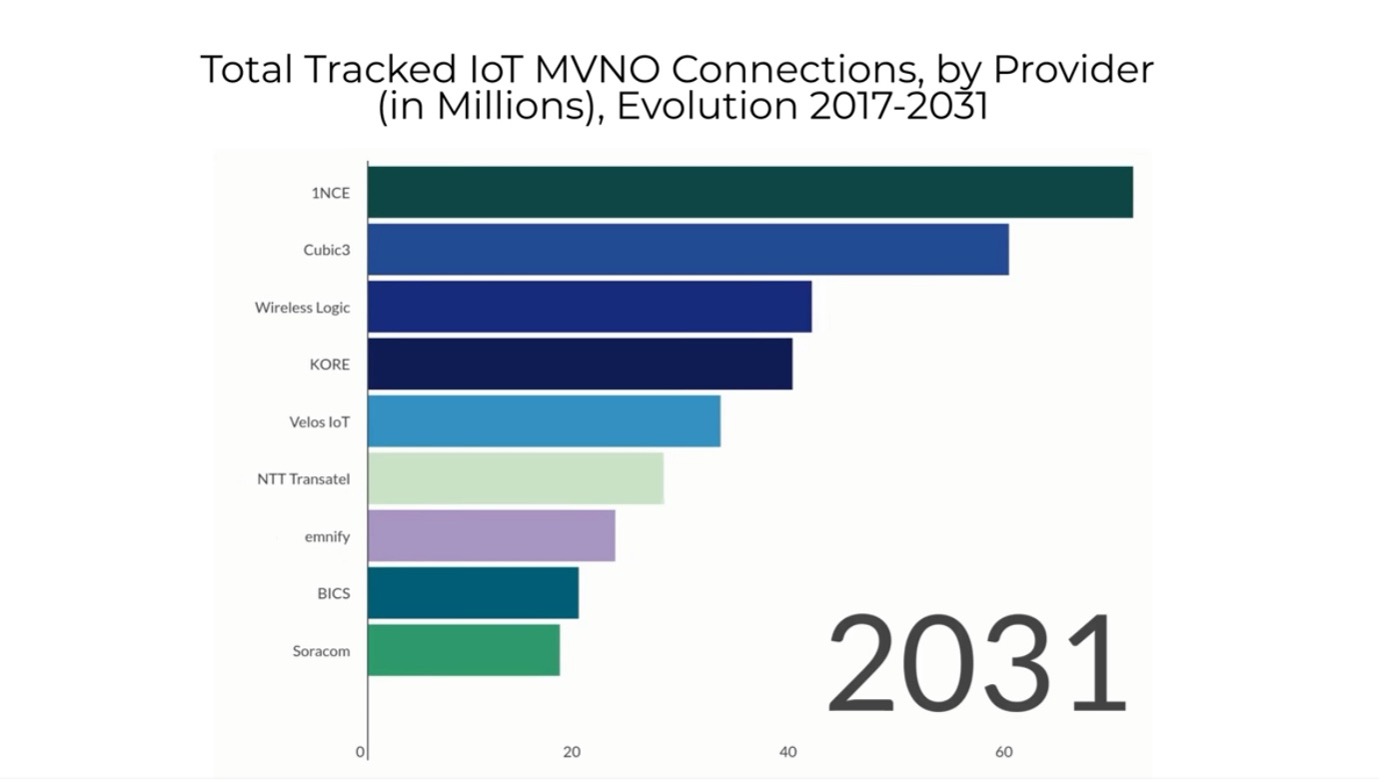
The top three IoT MVNOs accounted for 28% of all connections in 2025, but Kaleido stresses that connection volume alone does not define market strength – business models, vertical focus, and value‑added services increasingly shape competitive advantage.
Regional Growth and Sector Momentum
Kaleido identifies strong growth across North America, Europe, and Asia‑Pacific, with automotive, industrial IoT, and asset tracking leading adoption. The report analyses 27 major IoT MVNOs, including 1NCE, Cubic³, Wireless Logic, KORE, Velos IoT, Transatel, emnify, BICS, SORACOM, Eseye, and Telit Cinterion, mapping their vertical presence, regional footprint, and revenue mix across connectivity, management platforms, and VAS.
The Signaling Challenge Behind IoT Scale
As MNOs add new generations, they have started to face the same technical challenges as connectivity providers: complex multi‑network signaling, legacy interworking, routing anomalies, and rising security demands. MNOs now also increasingly operate across SS7, Diameter, HTTP/2, and 5G SBA, requiring unified, intelligent signaling cores to manage routing, policy, and protection.
This is where BroadForward’s market presence becomes visible. Many of the MVNOs highlighted by Kaleido – BICS, Velos, Transatel, 1NCE, Cubic³, Wireless Logic, KORE – rely on BroadForward advanced signaling capabilities to operate across heterogeneous networks. Their daily operations involve on-boarding customers, resolving signaling and vendor inconsistencies, managing multi‑technology roaming, and securing signaling interfaces. They have in common that many of their network functions run on the BroadForward BFX Unified Signaling Core (USC), which provides a common signaling platform designed to operate across legacy and next‑generation protocols- deployable on bare metal, VM or cloud. This has become an essential prerequisite to control costs, maintain manageability and remain scalable and secure.
A Market Defined by Intelligence, Not Just Connections
Kaleido’s analysis makes one point clear: the next phase of IoT MVNO growth will be defined not only by connection volume, but by intelligent, converged signaling, robust security, and the ability to manage global IoT fleets across diverse network technologies.