Global network traffic is projected to nearly quadruple to 3,789 exabytes (EB) per month by 2035, with artificial intelligence accounting for 44% of the total. According to Nokia’s Global Network Traffic Report 2026, generative AI, autonomous agents and physical AI will fundamentally change how networks carry and process data.
This is more than an increase in traffic volume. It marks a shift from predominantly download-oriented connectivity towards increasingly distributed, interactive and machine-driven communications.
The rise of autonomous AI
AI-related traffic is expected to grow considerably faster than conventional network traffic. Nokia forecasts that agentic AI traffic will increase 160-fold between 2026 and 2035, as autonomous agents increasingly interact with other agents, databases, applications and cloud platforms.
Independent research reinforces this trend. IDC forecasts that 2.5 billion specialized AI agents will be in production by 2030. Its research also points to widespread enterprise adoption of AI agent workflows.
These developments have implications beyond data volumes. Continuous interactions between autonomous systems will increase demand for reliable connectivity, low latency, security and efficient data exchange.
Networks become the AI execution layer
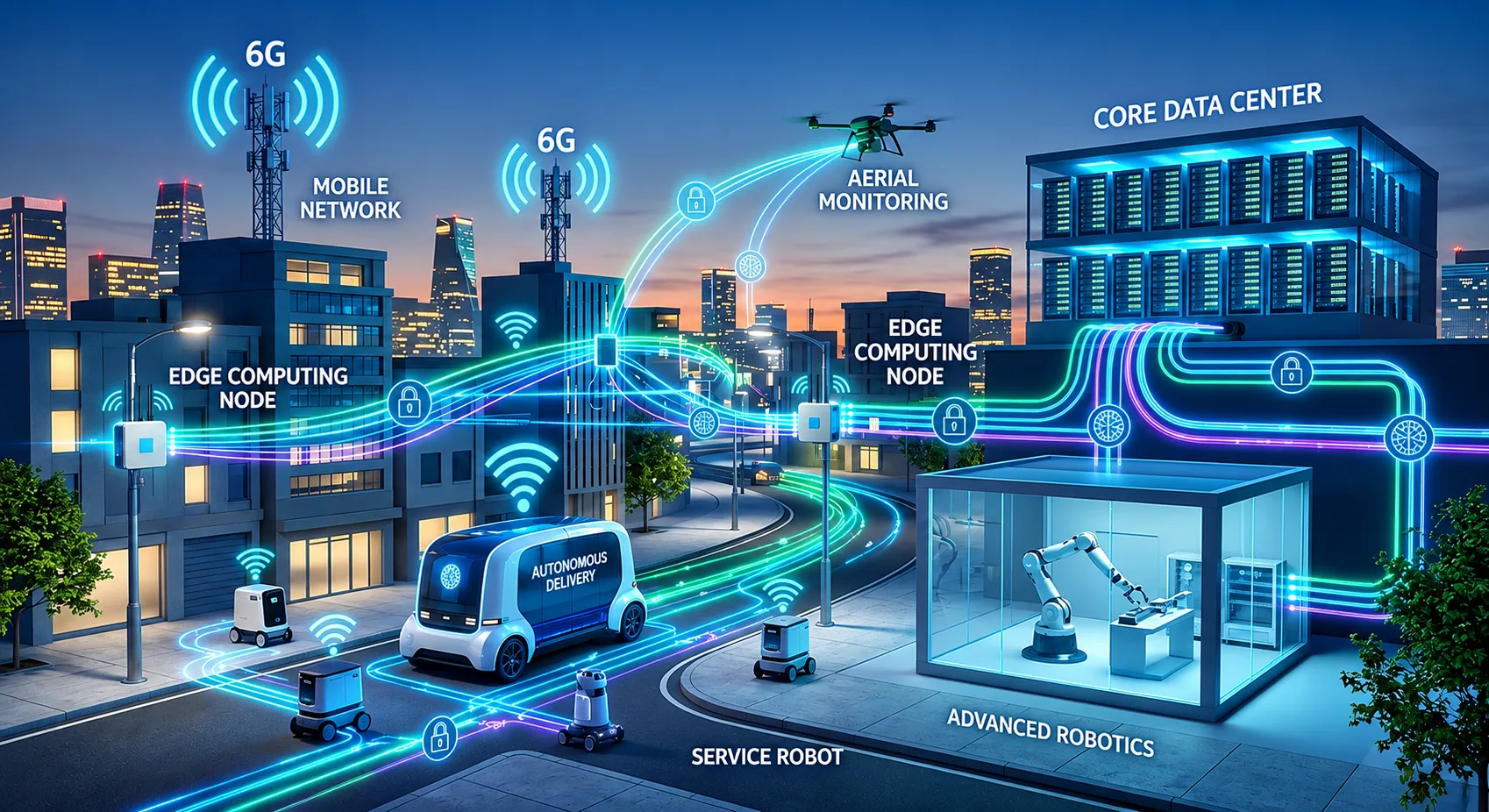
AI is also changing the balance of network traffic. Unlike conventional applications, physical AI systems such as robots, autonomous vehicles and connected cameras continuously transmit video, sensor and operational data.
Nokia forecasts that more than 90% of physical AI traffic will travel over the uplink by 2035. This creates new requirements for network capacity, responsiveness and traffic management.
Research from Cisco similarly projects that AI inference will account for 25% of total wide-area network (WAN) traffic by 2035.
At the same time, processing is moving closer to where data is generated. Nokia estimates that 36% of AI-native traffic will be handled by edge and metro-core infrastructure by 2035. Central cloud infrastructure will remain important, but distributed processing will become increasingly significant for latency-sensitive applications and data sovereignty.
Preparing networks for the AI era
The scale of this transformation creates both challenges and opportunities for telecom operators. They must accommodate more complex traffic patterns, growing uplink demand and increasingly autonomous connected systems.
This requires more than additional bandwidth. Networks will need intelligent routing, secure interworking, reliable signaling and the ability to manage communications across distributed infrastructure.
As autonomous AI systems increasingly interact across networks, trusted machine identities, secure signaling and intelligent routing become essential. The ability to authenticate, protect and efficiently exchange information between devices, platforms and network domains will be fundamental to maintaining reliable connectivity at scale.
For network infrastructure providers such as BroadForward, these developments reinforce the importance of intelligent signaling and security across increasingly interconnected telecom environments.
The next network evolution will not simply be about connecting more devices. It will be about enabling intelligent systems to communicate, interact and operate securely at scale.